
Acoustics in Religious Spaces: How Panels Improve Sound in Churches and Temples
Acoustics in temples are a challenge: high ceilings and stone walls amplify echo. How do acoustic panels solve this problem while preserving aesthetics and meeting the requirements of religious spaces?
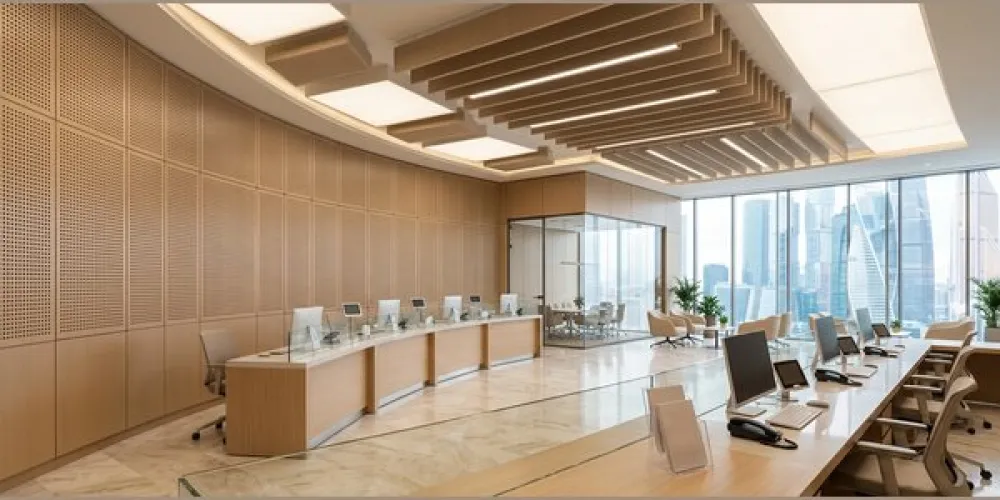
Acoustics in religious spaces are one of the most complex challenges for acoustic engineers. High vaults, stone walls, marble floors, and the absence of soft surfaces create conditions in which sound is reflected multiple times, producing echo and reverberation. As of April 2026, the reverberation time in untreated temples and churches can reach 4–6 seconds, making speech almost unintelligible and music blurred. Acoustic panels for temples and churches solve this problem, but their selection and placement require a special approach.
Features of acoustics in churches and temples
Religious buildings were designed for centuries without taking modern acoustic requirements into account. Their architecture combines large volumes, hard surfaces, and complex geometric forms that intensify reverberation. For example, in Orthodox churches with domes, sound is concentrated in the center of the room, creating the effect of echo under the dome. In Catholic cathedrals with high vaults, the priest’s speech can be lost in reflections, especially if the sound source is far from the congregation.
Main acoustic problems in temples and churches:
- Long reverberation time, more than 2 seconds, which interferes with speech intelligibility.
- Uneven sound distribution: in some areas it is too loud, while in others it is barely audible.
- Interference of sound waves, creating dead zones where the sound fades.
- Lack of low-frequency control, which is especially critical for organ music.
In temples and churches, acoustics must work in two directions: ensuring speech intelligibility and preserving the natural sound of music, says Alexey Morozov, acoustic engineer at Hilgen. This requires a balance between sound absorption and diffusion, which cannot be achieved simply by covering walls with soft materials. Specialized acoustic panels help solve this task, as they take into account the specifics of religious spaces.
Requirements for acoustic panels in religious spaces

The choice of acoustic panels for temples and churches is limited not only by technical requirements but also by aesthetic ones. Materials must match the architectural style of the building, preserve its historical appearance, and effectively absorb sound. The main criteria are:
- Fire safety. Materials must comply with fire hazard class KM1 or KM2 according to GOST 30244-94. In churches and temples where candles and oil lamps are used, this requirement is critical. For example, MDF acoustic panels with HPL coating belong to class KM2 and are suitable for most religious buildings.
- Aesthetics. Panels must harmonize with the interior. In Orthodox churches, panels with wood veneer finishes are often used; in Catholic cathedrals, neutral textures or painted finishes are common. Wooden or metal slatted systems are also popular because they can be integrated into architectural elements.
- Sound absorption. The sound absorption coefficient αw should be at least 0.7 for mid and high frequencies. To control low frequencies below 250 Hz, panels with perforation or special resonators are required. For example, microperforated panels effectively absorb sound in the range of 125–4000 Hz, which is optimal for temples and churches.
- Durability. Materials must withstand changes in temperature and humidity, especially in unheated churches and temples. HPL or metal panels are more resistant to such conditions than MDF.
When choosing acoustic panels, it is important to consider not only their technical characteristics but also the installation method. In historical buildings, drilling into walls or ceilings is often prohibited, so suspended systems or frame-mounted panels are used. For example, in one of Hilgen’s projects in 2025 for a church in Suzdal, suspended acoustic panels were used and attached to metal cables without damaging ancient frescoes.
Examples of acoustic solutions for temples and churches
Acoustic treatment of religious spaces requires an individual approach. Let us consider several typical solutions that have proven effective in practice.
1. Panels on walls and vaults
The most common solution is installing acoustic panels on walls and vaults. In churches with high ceilings, panels are placed at a height of 2–3 meters from the floor to avoid visually overloading the interior. For example, in St. Nicholas Church in Moscow, MDF panels with oak veneer finish were installed. Reverberation time decreased from 3.2 to 1.5 seconds, which significantly improved speech intelligibility.
To control low frequencies, perforated panels or Helmholtz resonators are used. In a Catholic cathedral in Saint Petersburg, metal acoustic slatted panels were installed. They effectively absorb sound in the 100–250 Hz range, which is critical for organ music.
2. Suspended ceiling systems
In temples and churches with high vaults, suspended ceiling systems make it possible to place panels closer to the sound source without disturbing the architecture. For example, in the Cathedral of Christ the Savior in Kaliningrad, suspended HPL acoustic panels were attached to metal trusses. This reduced reverberation time from 4.5 to 1.8 seconds without changing the appearance of the interior.
3. Slatted systems on walls and ceilings
Acoustic slatted panels are an optimal solution for religious buildings where a minimalist design must be preserved. They consist of horizontal or vertical wooden or metal slats with acoustic filling. In a mosque in Kazan, wooden perforated slatted panels were installed; they not only improved acoustics but also blended harmoniously into the interior.
Slatted systems are especially effective in rooms with large volumes, Hilgen acoustic engineers note. They make it possible to distribute sound absorption evenly across the entire area, avoiding the effect of dead zones.
How to preserve aesthetics during acoustic treatment
One of the main problems when installing acoustic panels in churches and temples is preserving the historical appearance of the building. Modern materials make it possible to solve this task without compromising acoustics.
- Use of natural materials. Panels with wood or stone veneer finishes are almost indistinguishable from natural materials. For example, in the Church of the Intercession on the Nerl, panels with a white stone finish were used, blending into the interior.
- Integration of panels into architectural elements. Panels can be built into columns, pilasters, or cornices. In one project in Novgorod, acoustic panels were installed behind wooden grilles, which helped preserve the historical appearance of the church.
- Painting and decorative coatings. Panels can be hand-painted or covered with printed images of frescoes or ornaments. In a church in Yaroslavl, panels painted to resemble frescoes were used; they not only improved acoustics but also became part of the interior.
- Suspended systems. In churches and temples where panels cannot be attached to walls, suspended systems are used. For example, in a cathedral in Rostov-on-Don, suspended panels were attached to the ceiling with metal cables.
Typical mistakes when choosing acoustic panels for temples and churches
Despite seeming simple, acoustic treatment of religious buildings is often accompanied by mistakes that cancel out all efforts. The most common ones are:
- Incorrect calculation of the number of panels. Customers often save money by reducing the number of panels, which results in insufficient sound absorption. For example, in one church in the Moscow region, only 20 m² of panels were installed instead of the required 80 m². Reverberation time decreased by only 0.3 seconds, which did not solve the problem.
- Placing all panels on one wall. Sound reflects from the opposite wall, and the effect of the panels is reduced to almost nothing. The main mistake is placing all panels on one wall, says Alexey Morozov. The sound will still reflect from the opposite side.
- Using unsuitable materials. For example, polyurethane foam or mineral wool panels are not suitable for temples and churches because of low fire safety and limited durability. In one project in Saint Petersburg, such panels had to be dismantled after a year due to deformation and mold.
- Ignoring low frequencies. Many projects are limited to panels for mid and high frequencies and forget about low frequencies. This is especially critical for organ music, which loses depth and volume. In a cathedral in Yekaterinburg, after panels without low-frequency control were installed, the organ sound became flat and unnatural.
- Failure to consider architectural features. For example, in churches with domes, sound is concentrated in the center, so panels need to be placed not only on walls but also on vaults. In one project in Moscow, panels were installed only on the walls, and the echo under the dome remained.
FAQ
Which acoustic panels are best suited for Orthodox churches?
For Orthodox churches, MDF panels with wood or stone veneer finishes are optimal. They meet aesthetic requirements, are fire-safe, class KM2, and effectively absorb sound in the 250–4000 Hz range. Perforated panels or Helmholtz resonators are used to control low frequencies.
Can acoustic panels be installed in historical churches?
Yes, but with caution. In historical buildings, suspended systems or frame-mounted panels are used to avoid damaging walls. Decorative panels that blend into the interior are also used. For example, in the Church of the Intercession on the Nerl, panels with a white stone finish were installed.
How can the required number of acoustic panels for a church be calculated?
The number of panels depends on the room volume, reverberation time, and the sound absorption coefficient of the material. The Sabine formula or specialized software is used for calculations. For example, a church with a volume of 1000 m³ and a reverberation time of 4 seconds would require about 80–100 m² of panels with αw = 0.8.
Can acoustic panels be used to improve organ sound?
Yes, but low frequencies must be considered. For organ music, perforated panels or resonators are required to absorb sound in the 100–250 Hz range. In a Catholic cathedral in Saint Petersburg, metal perforated slatted panels were installed, which significantly improved organ sound.
Which materials should not be used for acoustic treatment of temples and churches?
Materials with low fire safety, such as polyurethane foam, or materials with limited durability, such as mineral wool, should not be used. Panels without acoustic filling are also unsuitable because they do not provide sufficient sound absorption.
Acoustic treatment of religious spaces is a balance between technical requirements and preserving the historical appearance of the building. Properly selected and installed acoustic panels make it possible to improve speech intelligibility and music quality without disrupting the aesthetics of the temple or church. The main thing is to approach the task individually, taking into account the architecture and acoustics of each specific space.
Editorial team agronom.info
Materials are prepared by the portal's agronomists and editors. We use only trusted sources: Ukrainian agricultural universities, variety registries, open scientific publications.
Related articles


Not yet comments. Be the first!
Comments