
Poison darnel
Lolium temulentum
Description
How to tell it apart
Poison darnel is an annual grass species reaching heights of 30 to 90 cm. Its stems are erect, smooth, and often tufted, which allows the plant to compete effectively within cereal crops.
The leaves are linear, up to 5 mm wide, with a dark green color. The upper surface is rough to the touch, while the lower side is smooth and glossy, providing a clear visual marker for identification.
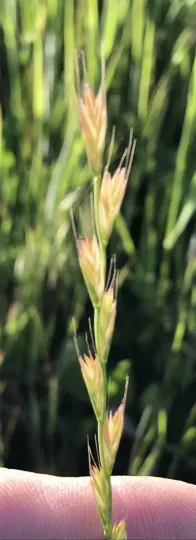
The inflorescence is a spike 10–20 cm long. The spikelets are attached singly to the nodes of the rachis, always edge-on to the stem, which is a characteristic feature of the Lolium genus.
The glumes of the spikelets are as long as or longer than the entire spikelet, which is a key diagnostic feature distinguishing it from other ryegrass species like perennial ryegrass.
The root system is fibrous and robust, allowing the plant to rapidly establish itself in fields and compete for soil moisture and nutrients against primary crops.
Where it grows
Poison darnel typically occurs as a segetal weed, specialized for growing alongside winter and spring cereals. It thrives in temperate climates and prefers fertile, nitrogen-rich soils.
It is commonly found in wheat, rye, and barley fields. It can also be seen along field margins, roadsides, and in fallow areas where land management has been neglected.
The plant prefers moist environments and can form dense patches that suppress growth of surrounding crops if allowed to propagate undisturbed over several seasons.
Its primary mode of spread is through contaminated seed lots. Because its grains are similar in size and weight to wheat grains, they are difficult to remove using standard cleaning machinery.
While modern agricultural practices have reduced its prevalence, it remains a persistent problem in organic and extensive farming systems where herbicides or rigorous seed cleaning are not utilized.
Harm it causes
The main danger of Poison darnel is its toxicity. The plant is often infected with a fungal endophyte that produces the alkaloid temuline, which is poisonous to both humans and livestock.
Consumption of flour contaminated with Poison darnel seeds can cause severe neurological symptoms, including dizziness, loss of coordination, blurred vision, and general lethargy.
Beyond its toxicity, it is a significant agricultural weed that competes for space, light, and water. Heavy infestations lead to substantial reductions in crop yields and grain quality.
The presence of darnel in harvested grain often leads to the rejection of the entire batch by grain elevators, causing serious financial losses for farmers who lack advanced separation technology.
Furthermore, the plant leaves a long-lived seed bank in the soil, meaning that a single season of uncontrolled growth can impact field cleanliness for several years thereafter.
How to control
The most important control strategy is the use of high-quality, certified seed that has been processed through optical sorters to remove weed grains that are similar to cereal seeds.
Crop rotation is an essential agricultural method. Rotating cereals with row crops allows for inter-row cultivation, which physically destroys weed seedlings before they mature.
Effective soil tillage, including autumn plowing followed by pre-sowing cultivation, helps to eliminate emerging seedlings and disrupts the weed's life cycle before planting.
Selective post-emergence herbicides can be used to manage infestations. These must be applied strictly according to the crop growth stage to ensure effectiveness and safety.
- Rigorous inspection and cleaning of all seed lots.
- Implementation of diverse crop rotation cycles.
- Mechanical removal of weeds from field edges and non-crop areas.
- Application of specialized grass herbicides according to local guidelines.
Taxonomy
- Latin name
- Lolium temulentum
- Family
- Однолетние злаковые