
Prostrate knotweed
Polygonum aviculare
Description
How to tell it apart
Prostrate knotweed, scientifically known as Polygonum aviculare, is an annual herbaceous weed belonging to the Polygonaceae family with a low-growing, mat-forming habit.
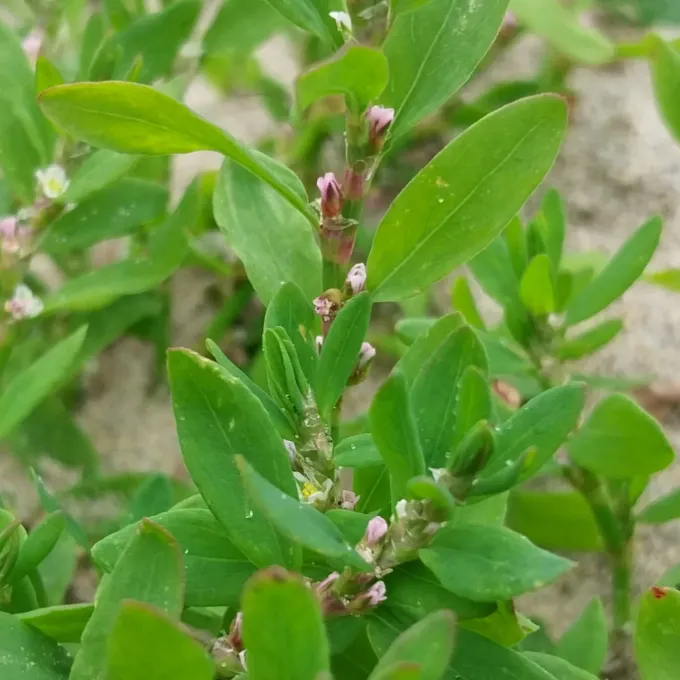
Its stems are branched, often lying flat against the ground, and possess the distinctive papery sheaths called ocreae at the nodes, which are characteristic of the knotweed family.
The leaves are small, bluish-green, and alternate, typically elliptical or lance-shaped, contributing to the plant's overall resilient and hardy appearance.
Flowers are minute, white to pinkish, and solitary or clustered in the leaf axils, blooming continuously from early summer through late autumn.
The root system is a deep-reaching taproot, allowing the plant to thrive even in dry or highly compacted soils where other crops struggle to survive.
Where it grows
Prostrate knotweed is a widespread species found globally in disturbed habitats, including agricultural fields, pastures, gardens, and along roadsides.
It is specifically adapted to compacted soil environments, often being the first plant to colonize heavily walked or driven areas where soil aeration is limited.
In farming, it frequently invades row crops, small grains, and vegetable patches, particularly in fields with low crop canopy cover or poor competition.
The weed is highly tolerant of foot traffic and physical disturbance, which allows it to persist in areas where more delicate vegetation is destroyed.
It thrives in full sunlight, which is why it becomes a major problem in thin, under-seeded, or poorly maintained crop rows during the growing season.
Harm it causes
The weed causes significant harm by competing with crop plants for vital moisture and nutrients, which can lead to reduced yield in water-stressed conditions.
Due to its prostrate growth, it can form dense mats that physically suppress emerging crop seedlings, preventing them from accessing necessary light and space.
Prostrate knotweed acts as an alternative host for various agricultural pests and viral diseases that can eventually damage high-value crop production.
It is difficult to manage mechanically once established because its taproot and tough stems make it resistant to light cultivation and surface disturbances.
Seed contamination is a major concern, as the small seeds are difficult to separate from harvested grain, leading to higher processing costs for farmers.
How to control
Effective cultural control includes maintaining a dense, healthy crop canopy through appropriate seeding rates and balanced fertilization to shade out the weeds.
Mechanical control involves timely inter-row cultivation or weeding when plants are small, before they have a chance to establish their tough, deep root systems.
Crop rotation serves as a powerful tool in breaking the weed's life cycle by alternating crops that require different management practices.
Chemical control via selective herbicides is recommended when infestation levels exceed the economic threshold, targeting the weed in its early growth stages.
Proper soil management, such as reducing unnecessary compaction in fields, can make the environment less favorable for prostrate knotweed germination and growth.
Taxonomy
- Latin name
- Polygonum aviculare
- Family
- Однолетние двудольные сорняки