
Patience dock
Rumex confertus
Description
How to tell it apart
Patience dock (Rumex confertus) is a perennial herbaceous plant belonging to the Polygonaceae family. It is a persistent weed characterized by a robust, short, and highly branched root system that can penetrate deep into the soil.
The plant features an erect, furrowed stem that can grow up to 150 centimeters in height. Its leaves are elongated, triangular, or ovate, with basal leaves being significantly larger than the upper ones, supported by long petioles.
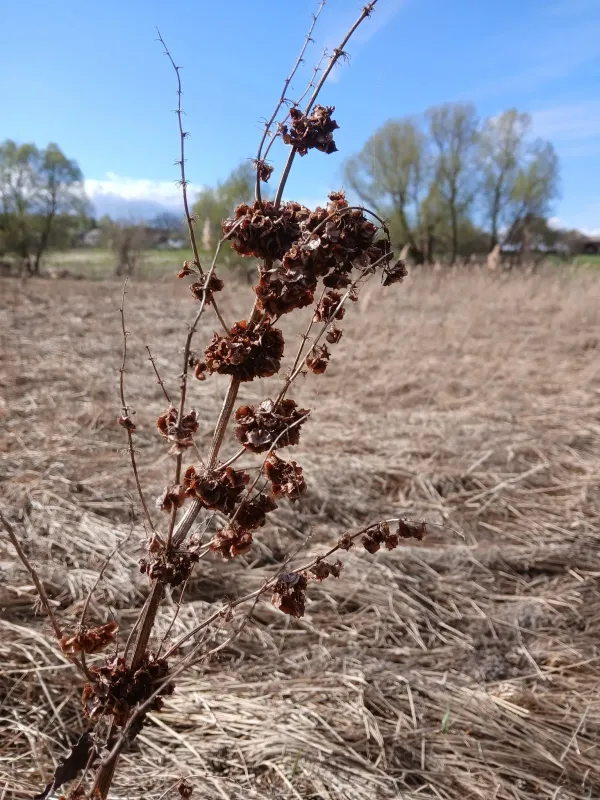
Blooming from May to June, the plant produces dense panicle-like inflorescences consisting of small greenish flowers. The fruit is a three-sided brown nutlet enclosed within the persistent perianth, which helps in seed dispersal.
It propagates mainly through seeds, with a single plant capable of producing thousands of nutlets per season. Seedlings can emerge from depths of up to 6 centimeters, making standard tillage methods less effective.
A key diagnostic feature of this species is the presence of membranous sheaths (ochreae) at the base of the leaf stalks, which is a hallmark of the buckwheat family.
Where it grows
Patience dock is widely distributed across Eurasia. It prefers moist, nutrient-rich soils, making it common in low-lying areas, near water bodies, and in riparian zones where moisture levels are consistently high.
The weed frequently infests meadows, pastures, and fallow lands, where it aggressively competes with desirable forage grasses. It is highly adaptable and can survive in diverse ecological conditions for many years.
In agricultural settings, it poses the greatest threat in poorly drained fields and areas prone to waterlogging. It is commonly found in multi-year grass stands, row crops, and fallow fields.
Patience dock thrives in compacted soils, quickly forming dense stands that prevent the growth of surrounding vegetation. Its deep root system allows it to access water and minerals that are unreachable for many shallow-rooted crops.
The plant often accumulates along field borders, fence lines, and irrigation ditches, where it serves as a source for seeds that are carried into cultivated fields by wind and water flow.
Harm it causes
The primary damage caused by patience dock is yield loss due to resource competition. The weed consumes vast amounts of water and soil nutrients, severely inhibiting the growth and development of adjacent cultivated crops.
Heavy infestation of this weed complicates mechanical harvesting. Its woody, coarse stems can clog machinery and increase the wear and tear of agricultural equipment, leading to higher fuel consumption and maintenance costs.
In pastures, it is considered a poor-quality forage plant. Due to its high oxalate content, it has low nutritional value and can be toxic to livestock if ingested in large quantities over time.
The plant also serves as an alternative host for various pests and diseases that affect commercial crops. This significantly increases the disease pressure on the field and may require more frequent phytosanitary interventions.
Furthermore, the presence of dock seeds in the harvested grain lowers the commercial value and purity of the crop, necessitating expensive and intensive cleaning processes before the grain can be marketed.
How to control
Managing patience dock requires an integrated strategy that combines mechanical and chemical methods. The most crucial mechanical measure is deep cultivation, cutting the roots at a depth of 15-20 centimeters to exhaust their reserves.
Deep fall plowing with moldboard inversion is effective in burying the roots and preventing seedling emergence, which helps to weaken the weed population before the next planting season begins.
In severely infested areas, crop rotation involving fallow periods is essential to break the weed's life cycle. Systematic disking after harvesting also contributes to reducing the density of the dock population.
Chemical control involves the application of systemic herbicides. The most effective results are achieved when the chemicals are applied during the rosette stage, well before the plant reaches the flowering phase.
Maintaining clean field margins and preventing the plant from going to seed is critical. Mowing should be done early in the season to stop the production of new seeds that could lead to future infestations.
Content graph
Connections · Patience dock
Most often together:
Marketplace
Products · 1
Biology
Taxonomy
- Latin name
- Rumex confertus
- Family
- Многолетние двудольные