
Common yarrow
Achillea millefolium
Description
How to tell it apart
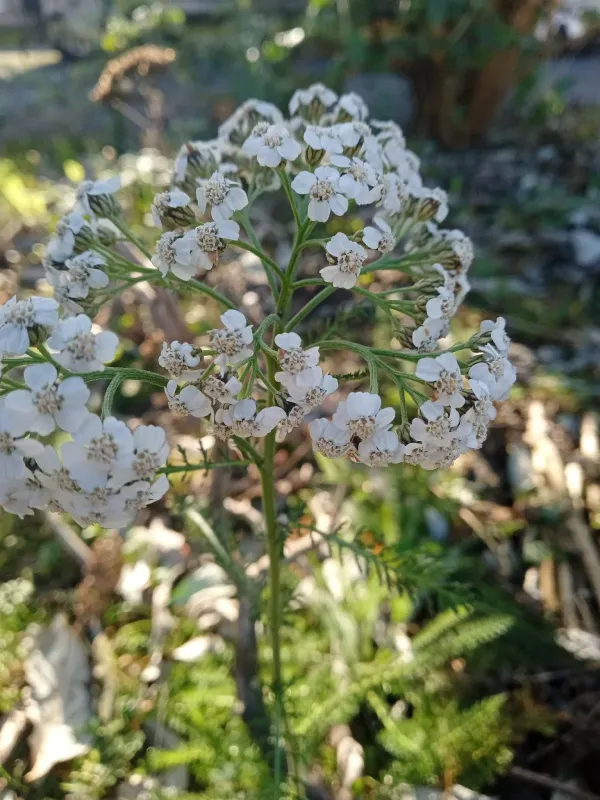
Common yarrow (Achillea millefolium) is a member of the Asteraceae family. It is a hardy, herbaceous perennial plant characterized by its rhizomatous growth.
The stems are erect, reaching up to 80 cm in height, and are covered in fine, silky hairs. The leaves are feathery, finely dissected, and arranged alternately along the stem.
Flowers are arranged in dense, flat-topped clusters called corymbs. The individual florets are typically white or pale pink and have a strong, distinct aroma.
The root system consists of creeping rhizomes that allow the plant to spread rapidly and form dense colonies across fields.
Yarrow is highly prolific, with each plant capable of producing thousands of tiny seeds that are easily dispersed by wind, water, and machinery.
Where it grows
Common yarrow is widely distributed throughout the temperate regions of the Northern Hemisphere. It thrives in grasslands, pastures, and disturbed soil.
In agricultural settings, it is commonly found in permanent pastures, fallow fields, and occasionally in winter cereals where tillage is minimal.
It prefers well-drained soils and sunny locations but is highly adaptable to various soil types, including compacted and nutrient-poor ground.
The plant often establishes itself along field borders, drainage ditches, and roadsides, serving as a source for further colonization of cultivated fields.
Due to its high adaptability, it can quickly colonize areas where natural competition has been removed through overgrazing or soil disturbance.
Harm it causes
Yarrow competes aggressively with crops for light, moisture, and soil nutrients, often resulting in significant yield losses in infested areas.
The dense rhizomatous growth can physically obstruct the development of crop seedlings, particularly in the early stages of the growing season.
Contamination of harvested grain with yarrow seeds lowers the commercial value and requires additional cleaning processes to meet quality standards.
The plant serves as an alternative host for various agricultural pests and pathogens, potentially increasing the risk of disease spread within the field.
In pastures, while sometimes eaten by livestock, large infestations can crowd out more nutritious forage species, reducing the overall carrying capacity.
How to control
Mechanical control through deep primary tillage is effective in breaking up rhizome networks and exhausting the plant's energy reserves.
Regular mowing or cultivation of fallow fields prevents the weed from producing seeds and helps weaken established patches over time.
Strategic grazing management can prevent yarrow from gaining a competitive advantage in permanent pasture areas.
For large-scale infestations, systemic herbicides containing glyphosate applied post-harvest are highly effective at killing the rhizomes.
Selective post-emergence herbicides are recommended in active crop fields to manage yarrow populations while ensuring minimal damage to the primary crop.
Taxonomy
- Latin name
- Achillea millefolium
- Family
- Многолетние двудольные