
Sea lettuce
Ulva intestinalis
Description
How to tell it apart
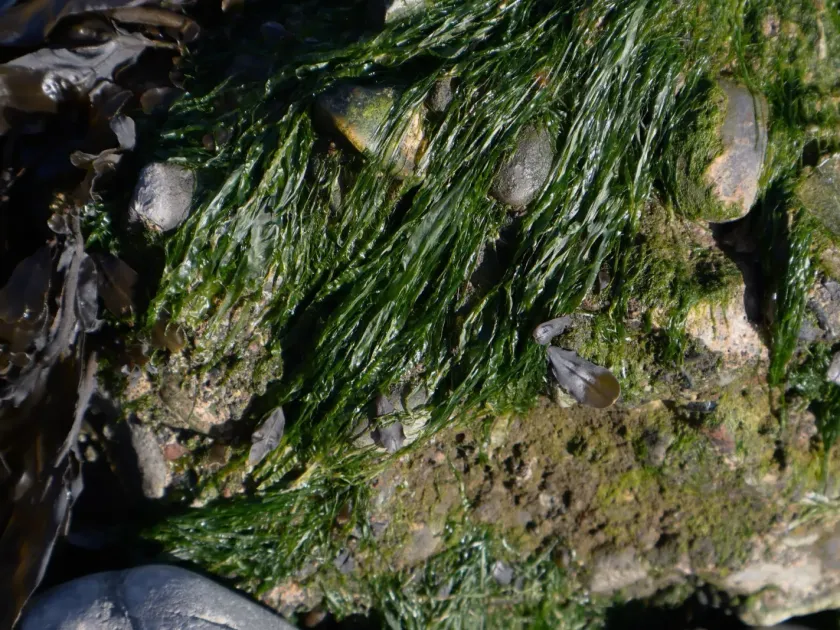
Ulva intestinalis is a multicellular green alga belonging to the Ulvaceae family. Its thallus is characterized by tubular, hollow filaments that resemble long, bright green ribbons.
The morphology is distinct, often described as sac-like or inflated, giving it an appearance similar to entrails, which is the origin of its specific name.
Lacking true roots, it attaches to substrates using a basal holdfast disk. In many cases, it remains unattached, forming dense, floating mats that cover large surface areas.
The structure consists of a two-cell-thick membrane that provides significant elasticity, allowing it to withstand high-energy wave action or current flow.
Biological resilience is a hallmark of this species, as it thrives under varying salinity, nutrient concentrations, and temperature regimes, making it a highly successful colonizer.
Where it grows
Ulva intestinalis is widely distributed in coastal areas, estuaries, lagoons, and brackish water environments, often where nutrient inputs are high.
In agricultural regions, this alga creates major issues in irrigation channels, drainage ditches, and managed ponds, particularly in warm climates.
It prefers high-nutrient environments, often proliferating rapidly in waters affected by agricultural runoff rich in nitrogen and phosphorus from fertilizers.
The plant can colonize almost any hard surface, including canal concrete walls and flood control infrastructure, as well as growing epiphytically on other plants.
Rapid growth cycles occur during the spring and summer months, fueled by high levels of light penetration and sufficient availability of dissolved nutrients.
Harm it causes
The primary impact of Ulva intestinalis is its massive bloom potential, which creates dense mats that block sunlight, effectively suffocating submerged aquatic vegetation.
In agricultural settings, it clogs irrigation infrastructure, including filters, pumping stations, and intake pipes, causing substantial operational downtime and costs.
As the algae die, the massive biological decomposition process depletes oxygen levels in the water column, leading to hypoxia and potential fish kills.
In rice paddies, intense algal growth competes directly with crop seedlings for essential nutrients and creates physical obstructions to root development.
Furthermore, the presence of these algae reduces water quality, making it unsuitable for sensitive aquatic environments and intensive fish farming operations.
How to control
The most effective long-term management strategy involves reducing nutrient loading in runoff, which limits the nitrogen and phosphorus supply essential for blooms.
Mechanical harvesting is a standard practice for clearing clogged channels, although it must be frequent and consistent to keep the biomass at manageable levels.
Chemical control via algicides is possible but must be performed with caution to avoid toxic effects on non-target species and overall ecosystem health.
Biological controls, such as the introduction of algae-grazing fish or invertebrates, can assist in limiting growth in contained ponds and managed reservoirs.
- Reducing agricultural nutrient runoff.
- Routine mechanical harvesting.
- Strategic use of targeted algicides.
- Water aeration to mitigate hypoxia.
- Monitoring nutrient concentrations in irrigation water.
Taxonomy
- Latin name
- Ulva intestinalis
- Family
- Ульвовые
- EPPO code
- ENOIN