
Hawkweed-leaved saxifrage
Micranthes hieraciifolia
Description
How to tell it apart
The hawkweed-leaved saxifrage, scientifically known as Micranthes hieraciifolia, is a perennial herb belonging to the Saxifragaceae family.
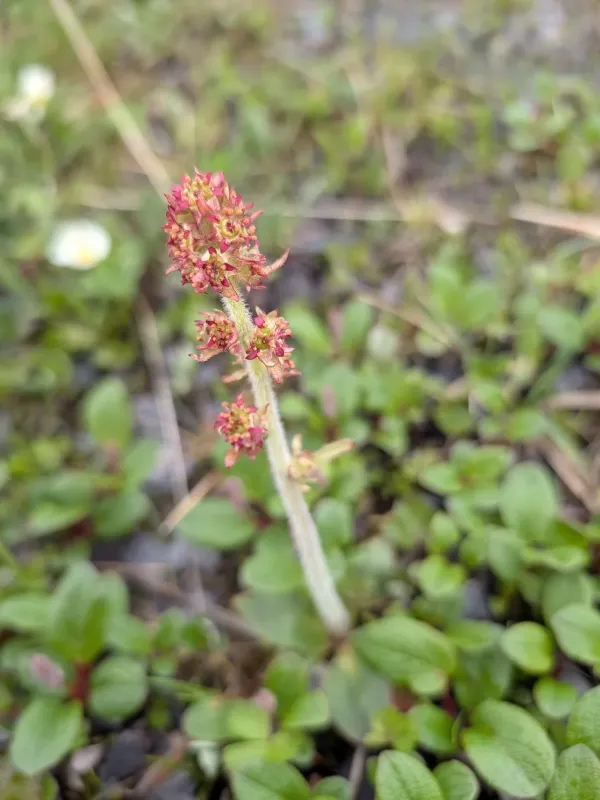
It is characterized by an erect stem that can reach heights of up to 30 centimeters, often showing glandular hairs along its structure.
The leaves are primarily basal and arranged in a rosette; their shape is oblong-ovate with slightly serrated margins, resembling those of hawkweed.
The inflorescence is typically a dense, spike-like or raceme cluster of small flowers that exhibit a dull purple or reddish-green hue.
Its root system is fibrous and shallow, adapted to living in moist, cold soil conditions common in arctic and high-altitude regions.
Where it grows
This species is well-adapted to cold, damp environments such as tundra regions, wetlands, and mountain slopes where conditions are harsh.
In agricultural settings, it is found in poorly drained meadows and northern pastures that suffer from chronic waterlogging and acidic soil.
It thrives in areas with low vegetative competition, quickly colonizing disturbed patches of soil near irrigation channels or damp field borders.
The plant demonstrates high resilience to frost and short growing seasons, making it a persistent inhabitant of subarctic agricultural landscapes.
Its ability to establish in open spaces makes it a common colonizer in meadows where the grass sward has been compromised by grazing or erosion.
Harm it causes
The primary agricultural impact of this weed is the reduction of forage quality in pastures, as it competes with nutritious grass species.
By forming dense patches, it limits the growth of desirable forage crops, leading to lower overall biomass production in the affected areas.
The plant is often avoided by livestock, which means it can dominate pastures and reduce the total amount of usable feed available for animals.
In fields with heavy infestation, the presence of this weed complicates harvest operations and uniform maintenance of the grassland.
Its nutrient uptake can be a concern in soils where nitrogen levels are already limited, further suppressing the growth of cultivated grasses.
How to control
Improving field drainage is the most effective long-term strategy, as the plant depends on high moisture levels to maintain its competitive edge.
Regular mowing before the flowering stage prevents seed set, significantly curbing the spread of this plant across the field.
Tillage practices such as plowing are effective for mechanical removal, as the shallow roots are easily disrupted during soil cultivation.
Chemical control can be implemented using selective herbicides, though it is usually reserved for areas where the infestation is severe.
Applying lime to the soil can help correct acidity, creating a less favorable environment for the growth of Micranthes hieraciifolia.
Taxonomy
- Latin name
- Micranthes hieraciifolia
- Family
- Камнеломковые
- EPPO code
- SXFHR