
Western starflower
Trientalis latifolia
Description
How to tell it apart
Western starflower (Trientalis latifolia) belongs to the Primulaceae family. It is a perennial herbaceous plant characterized by its delicate yet persistent growth habit.
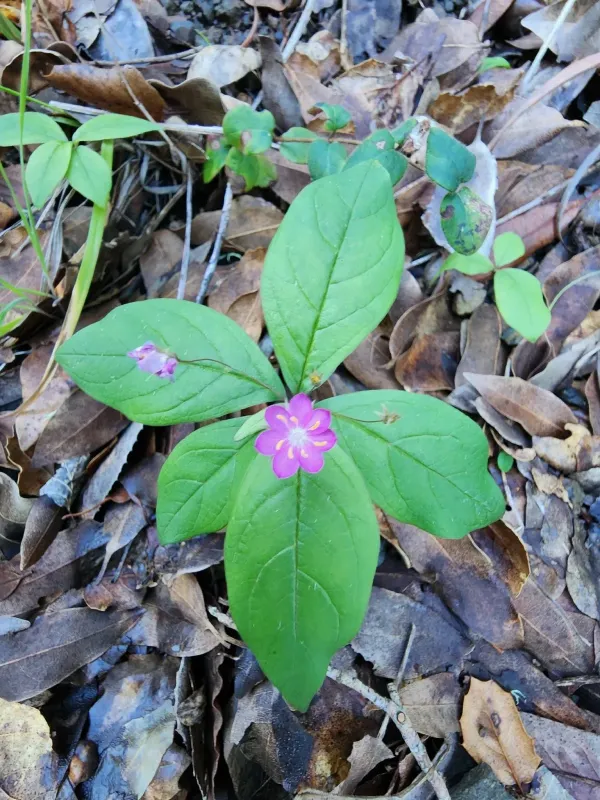
The plant is distinguished by leaves arranged in a whorl at the top of the stem, often displaying an obovate or elliptical shape that is highly recognizable.
Its flowers are typically white to pink, with five to seven petals, which gives the plant its common name and distinct appearance in the field.
The biological nature of the starflower includes thin, creeping rhizomes that allow it to spread across the soil surface and form dense patches.
Unlike some aggressive weeds, it grows steadily and adapts to shaded areas, though it can become a nuisance in specific agricultural conditions.
Where it grows
This species is native to western North America, commonly inhabiting moist forests, thickets, and woodland clearings where moisture is abundant.
As a weed, it is found in fields that have been recently converted from woodland, or in agricultural sites that border moist, riparian ecosystems.
It favors acidic, nutrient-rich, and damp soil conditions, often colonizing areas where drainage is poor or water tends to accumulate.
It is rarely a dominant weed across large expanses but can be found in clusters where ecological conditions favor its development over crop growth.
The distribution of this plant is often correlated with undisturbed or semi-disturbed soil, making it more common in low-intensity cultivation systems.
Harm it causes
The primary harm caused by Trientalis latifolia involves competition with agricultural crops for limited resources such as sunlight, soil moisture, and nutrients.
Its ability to propagate vegetatively via rhizomes means it can quickly occupy gaps in crop stands, reducing overall yield and field uniformity.
While not a parasitic plant, it competes with crops in the rhizosphere, potentially stunting growth in sensitive plants during early development stages.
The presence of the starflower complicates field management, as its persistent rhizomes make mechanical weeding more difficult and labor-intensive.
In cases of high density, it can interfere with harvest operations and potentially affect the health of the primary crop through shared moisture stress.
How to control
Cultural control methods are essential, focusing on deep tillage to break up the rhizome network and disrupt the weed's ability to propagate.
Effective crop rotation, especially involving dense or tall-growing crops, can shade out the starflower and restrict its expansion in the field.
Chemical control involving systemic herbicides is recommended for managing established patches, provided they are applied during the active growth phase.
Integrated weed management should prioritize maintaining proper field drainage to reduce the specific soil moisture levels the weed requires.
- Use of systemic herbicides for site-specific treatment.
- Regular mechanical cultivation to weaken rhizome energy reserves.
- Selection of competitive crop varieties that cover the soil quickly.
- Field sanitation to prevent the spread of rhizome segments.
Taxonomy
- Latin name
- Trientalis latifolia
- Family
- Первоцветные
- EPPO code
- TNTLA