
Brookweed
Samolus valerandi
Description
How to tell it apart
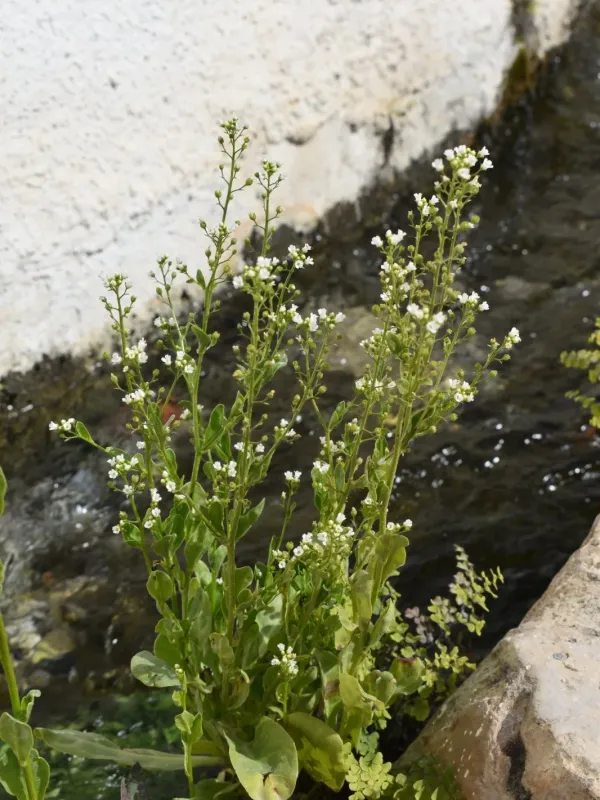
Samolus valerandi, commonly known as Brookweed, belongs to the Primulaceae family. It is a perennial herbaceous plant with an upright, often branched stem reaching heights of 10 to 50 centimeters.
The leaves are obovate or spatulate, entire, with short petioles. The plant's root system is relatively weak but well-adapted to waterlogged soil conditions.
The flowers are small, white, and arranged in loose racemes or corymbs at the tips of the stems. The calyx is five-toothed and persists as the fruit develops.
The fruit is a spherical capsule that opens with five valves. The seeds are very small and numerous, providing the plant with a high potential for dispersal.
As a moisture-loving perennial, it is frequently found as a component of plant communities in saline or excessively damp agricultural areas.
Where it grows
The primary habitats for Samolus valerandi are damp and wet locations such as stream banks, marshes, flood meadows, and drainage ditches.
In agricultural settings, this weed is typically found in crops grown on reclaimed land with poor drainage and high water tables.
The plant prefers sandy or silty substrates and is often found in areas with higher salt concentrations, making it a bioindicator of specific soil conditions.
It is distributed throughout temperate and subtropical regions, colonizing low-lying areas of fields where regular agricultural operations are impeded.
While it rarely forms dense monocultures, its presence is a clear indicator that improvements to the hydrological regime of the field are required.
Harm it causes
The main harm caused by Samolus valerandi is its ability to rapidly colonize waterlogged areas of fields, competing with crops for space and light.
The presence of this weed hinders mechanized harvesting because it creates localized areas of high soil moisture, which often leads to machinery downtime.
The plant acts as an indicator of land degradation, as its mass appearance suggests failure in drainage systems or chronic soil saturation.
Although the plant is not highly toxic to crops, it indirectly promotes the spread of diseases by creating a favorable microenvironment for pathogens.
In pastures and meadows, it can outcompete more valuable forage grasses, thereby reducing the overall nutritional quality of the vegetation.
How to control
Effective control of this weed is primarily based on agrotechnical measures aimed at regulating the soil water balance.
The key management method is improving drainage and implementing land reclamation works that render the soil unsuitable for this moisture-loving species.
Deep autumn plowing helps suppress seed spread and destroys the plant's root system before the start of the new growing season.
Chemical control is possible using broad-spectrum herbicides applied when significant infestations are discovered, though efficacy is limited by the specific sites of growth.
It is essential to maintain irrigation systems and channel banks properly to prevent the further spread of weed seeds into cultivated agricultural crops.
Taxonomy
- Latin name
- Samolus valerandi
- Family
- Первоцветные
- EPPO code
- SADVA