
Chaffweed
Lysimachia minima
Description
How to tell it apart
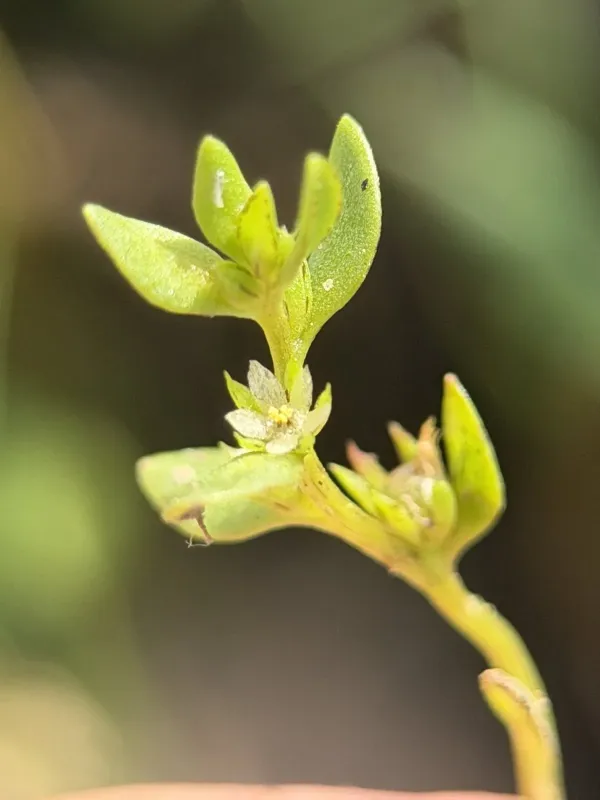
Chaffweed (Lysimachia minima), formerly classified as Centunculus minimus, is a member of the Primulaceae family. It is a tiny annual herb, usually growing no taller than 10 centimeters in height.
The leaves are small, ranging from ovate to obovate, and are arranged alternately or oppositely along the stems. They are bright green, glabrous, and often sit close to the main stem, making them blend into the background.
The flowers are extremely inconspicuous, located in the leaf axils. They have a small, four- or five-parted corolla that is white to pale pink in color, appearing during the summer months.
The fruit is a globular capsule that splits open to release a high number of minute seeds. These seeds are easily transported by runoff water or attached to agricultural machinery.
Due to its diminutive stature, chaffweed is frequently overlooked by farmers until it forms a dense, carpet-like cover across saturated patches of the field.
Where it grows
Chaffweed is a characteristic species of damp, marshy environments. It thrives in locations where water saturation is consistent and the soil lacks proper drainage.
In agricultural settings, it is primarily found in low-lying depressions, along irrigation ditches, or in areas where snowmelt or rainfall stagnates for extended periods.
The weed serves as an indicator species for poor soil drainage. Its presence often alerts agronomists to localized compaction or waterlogging issues that need remediation.
It is capable of enduring periods of minor flooding, giving it a competitive advantage over more sensitive crops that may suffer from oxygen deprivation in the root zone.
It is widespread across temperate regions of Eurasia and North America, typically appearing in cultivated fields during wet seasons or in poorly managed, low-lying tracts.
Harm it causes
The harm caused by chaffweed lies in its tendency to form thick mats over the soil surface, which restricts soil aeration and can lead to oxygen stress for young crop roots.
As a competitor for space and nutrients, it interferes with the early development of seedlings, potentially reducing the overall vigor of the crop stand.
The dense cover of chaffweed maintains high humidity levels at the soil-crop interface, which creates an ideal environment for the proliferation of various soil-borne fungal pathogens.
Its presence complicates field operations, as the wet soil conditions required for its growth make mechanical cultivation difficult and increase the risk of soil structure damage.
While not a primary economic pest, its mass colonization can significantly hinder crop establishment and reduce yields in localized areas of the field.
How to control
The primary strategy for managing chaffweed is the improvement of field drainage. Implementing tile drainage or land leveling helps eliminate the waterlogged conditions the plant requires.
Mechanical control through tillage and regular inter-row cultivation is highly effective, as it uproots the plant and helps dry out the topsoil, disrupting its life cycle.
Crop rotation incorporating vigorous, fast-growing species that canopy quickly can effectively suppress chaffweed by limiting the light available for its growth.
Chemical control is generally not recommended as a standalone measure but can be applied if the weed infestation is widespread and interfering with crop development.
Long-term management should focus on soil structure improvement and irrigation management to ensure that field conditions are less favorable for this opportunistic weed species.
Taxonomy
- Latin name
- Lysimachia minima
- Family
- Первоцветные
- EPPO code
- ANGMI