
Navarretia squarrosa
Navarretia squarrosa
Description
How to tell it apart
Navarretia squarrosa, commonly known as skunkweed, is an annual herb belonging to the Polemoniaceae family, recognizable by its distinctively pungent odor.
The plant typically grows to a height of 10–50 cm and features stiff, erect, branched stems covered in glandular, sticky hairs that produce a strong, unpleasant scent.
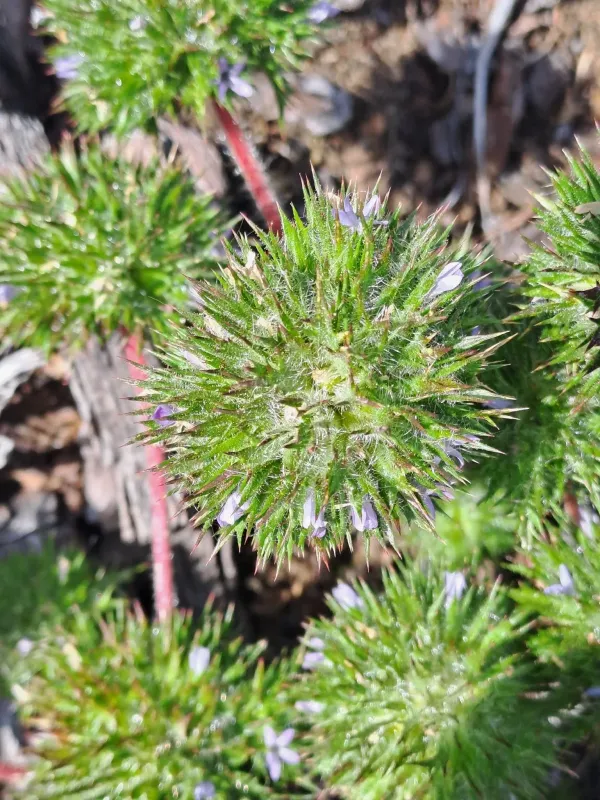
Its leaves are alternate and pinnately divided into narrow, spine-tipped segments, which give the plant a very prickly and intimidating physical appearance.
The flowers are clustered in dense, head-like inflorescences surrounded by sharp, bract-like structures, usually ranging from blue to violet in color.
Seeds are produced within dry, dehiscent capsules that disperse easily, facilitating the rapid spread of the species across disturbed lands and crop fields.
Where it grows
Native to western North America, this species has become an invasive weed in various parts of the world, thriving in Mediterranean-type climates.
It prefers dry, open habitats such as gravelly or sandy soils, roadsides, pastures, and neglected farmlands where it can easily colonize bare ground.
In agricultural settings, it frequently infests cereal crops and forage pastures, exploiting areas where the crop stand is thin or poorly established.
The plant is highly resilient to drought, allowing it to survive and flourish in conditions that would otherwise limit the growth of more sensitive vegetation.
It often appears along field margins and irrigation ditches, utilizing these paths as corridors for further dispersal into the heart of agricultural production zones.
Harm it causes
The primary impact on agriculture is the contamination of harvested products, as the plant's sharp bristles and seeds are difficult to separate from grain.
Its prickly nature damages harvesting machinery and significantly slows down field operations, leading to increased labor costs and maintenance requirements.
It acts as a strong competitor for soil moisture and nutrients, which results in reduced biomass and yield for the intended agricultural crop.
Livestock avoid grazing on land infested with skunkweed because the sharp, spiny inflorescences can cause physical injury to the animals' mouths and skins.
The strong, unpleasant odor associated with the plant can degrade the quality of forage or hay, rendering it unpalatable or entirely unsuitable for livestock feed.
How to control
Mechanical control through deep tillage is highly effective in burying seeds and preventing them from reaching the necessary germination depth in the soil.
Implementing a diverse crop rotation system is crucial for breaking the lifecycle of the weed and reducing the overall seed bank in the soil over time.
Mowing or hand-pulling the weed before it reaches the flowering stage is essential to prevent the production of new seeds and control local populations.
Chemical control involving selective herbicides applied at the rosette or early growth stage is often required to achieve significant reduction in dense infestations.
Proper field hygiene, including the cleaning of agricultural machinery before moving between different zones, helps prevent the accidental introduction of seeds.
Taxonomy
- Latin name
- Navarretia squarrosa
- Family
- Синюховые
- EPPO code
- NAVSQ