
Needle-leaf navarretia
Navarretia intertexta
Description
How to tell it apart
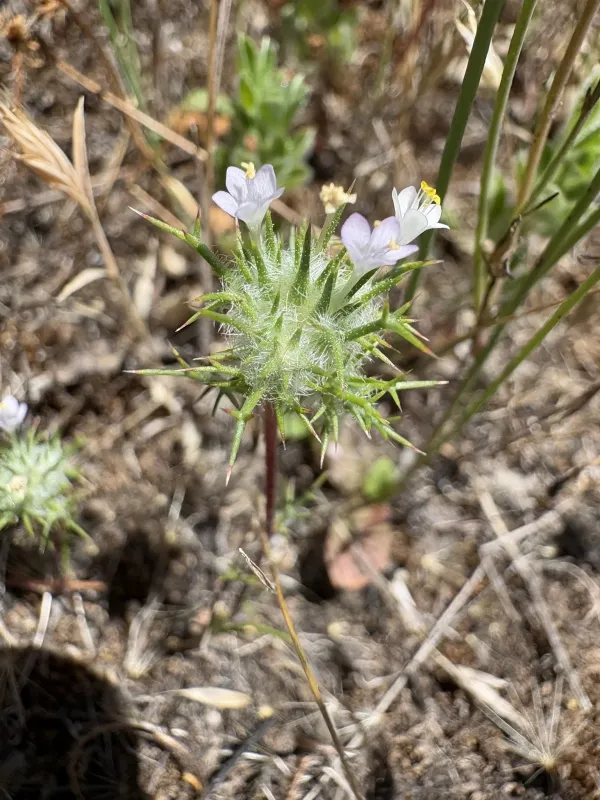
Needle-leaf navarretia (Navarretia intertexta) belongs to the Polemoniaceae family. It is an annual herbaceous plant with a simple or branched stem, typically ranging from 5 to 30 centimeters in height.
The leaves are alternate and deeply divided into narrow, linear segments, which give them a needle-like appearance. The inflorescences are dense, head-shaped clusters surrounded by characteristic, spiny, interlocked bracts.
The flowers are small, with corollas ranging in color from pale blue to white. The plant produces numerous small seeds that can remain viable in the soil for several years.
Its root system is taproot-based, slightly branched, allowing the plant to efficiently utilize moisture in the upper soil layers. Seedlings typically emerge in the spring when conditions are favorable.
The entire appearance of the plant, from its spiny bracts to its stiff pubescence, serves as an adaptation to the arid environments typical of its native range.
Where it grows
This species is native to western North America. It thrives in open, sunny areas with moist soil during the spring, which later dries out as the season progresses.
In its natural habitat, it is frequently found in wet meadows, the edges of seasonal ponds, depressions, and along roadsides. The plant is well-adapted to disturbed soils.
As a weed, it invades agricultural fields, particularly in grain crops and pastures where areas of excess spring moisture are present.
Navarretia spreads easily through rainwater runoff or by being transported via agricultural machinery, which collects seeds on its working parts during cultivation.
It prefers clay or loam soils where moisture is retained, providing a competitive advantage over other species during the early stages of the growing season.
Harm it causes
The primary damage caused by Navarretia intertexta is the intense competition it creates with crops for space, water, and nutrients during early growth stages.
Due to its high density, the weed can significantly suppress the development of grain seedlings, leading to reduced stand density and overall lower crop yields.
The spiny flower heads and bracts pose serious problems during mechanical harvesting, as they contaminate the grain mass, reducing both quality and market value.
The presence of this weed in pastures is undesirable because its stiff and spiny parts can injure the oral mucosa of livestock grazing on the vegetation or consuming hay.
The plant may also serve as a reservoir for certain insect pests and plant pathogens, which can migrate to crops, increasing the risk of disease outbreaks.
How to control
The primary control strategy is high-quality pre-sowing soil cultivation, aimed at eliminating weed seedlings before the emergence of the crop.
An effective agrotechnical method involves crop rotation, including plants that create a dense canopy to shade the soil and naturally suppress weed growth.
Maintaining proper drainage systems in the fields is crucial, as reducing waterlogged areas makes the environment less favorable for this specific weed.
When chemical control is necessary, post-emergence systemic herbicides are used, although the choice of product must comply with specific crop protection guidelines.
Hand weeding or mowing the weed before seed formation on small patches is an effective way to prevent the further dispersal of seeds throughout the field.
Taxonomy
- Latin name
- Navarretia intertexta
- Family
- Синюховые
- EPPO code
- NAVIN