
Phytolacca rigida
Phytolacca rigida
Description
How to tell it apart
Phytolacca rigida is a perennial herbaceous plant belonging to the Phytolaccaceae family, known for its significant competitive ability in agricultural environments.
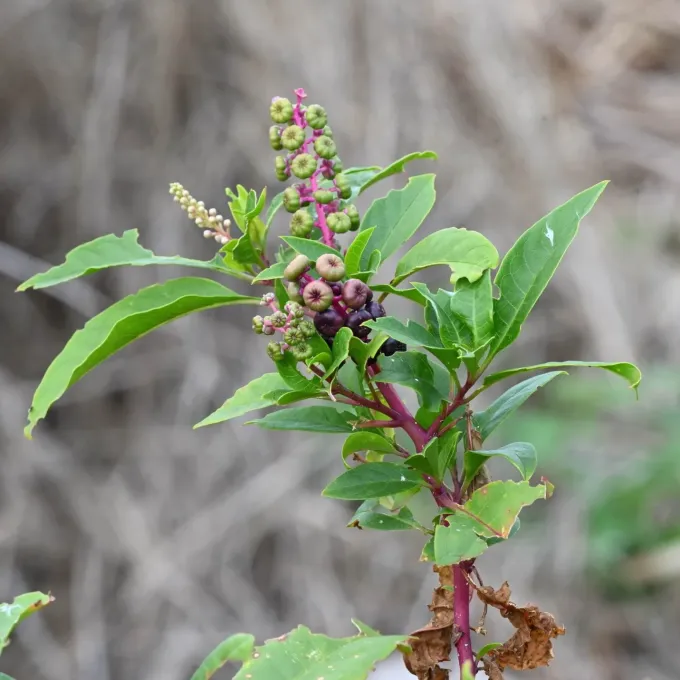
The plant features a robust, upright stem that can become woody towards the end of the season and large, lanceolate leaves arranged alternately along the stem.
Its most characteristic features include long racemes of flowers that develop into dense clusters of dark purple or black berries after the flowering period.
It possesses a massive, fleshy taproot that extends deep into the soil profile, providing the plant with excellent regenerative capacity and drought tolerance.
The plant contains toxic compounds in all its parts, particularly in the roots and unripe fruits, which requires careful handling to avoid skin irritation or accidental ingestion.
Where it grows
Phytolacca rigida typically favors moist, fertile soils and is commonly found in abandoned agricultural lands, field margins, and along forest edges.
It is particularly problematic in row crops like corn or sunflowers, where it exploits open spaces and high nutrient levels in the soil.
The plant is highly adaptable and thrives in disturbed habitats where it faces little competition from other perennial vegetation, allowing it to colonize rapidly.
Seed dispersal is largely driven by birds that consume the berries, leading to widespread and often unpredictable infestations in new agricultural areas.
Often found near livestock facilities or rural gardens, the plant benefits from the high soil organic matter, which supports its vigorous vegetative growth.
Harm it causes
The primary damage caused by this weed is the severe competition with crops for water, light, and nutrients, leading to significant yield losses in infested areas.
Its deep root system depletes soil moisture reserves, which is especially detrimental to crop development during peak summer heat or drought conditions.
The height and density of the stems create extensive shading for low-growing crops, which suppresses their development and reduces overall biomass production.
Contamination of harvested grain with the toxic berries is a serious quality issue, necessitating costly mechanical cleaning or causing rejection at processing facilities.
The fibrous and tough nature of the stems can cause mechanical issues, potentially damaging harvesters and tillage equipment during field operations.
How to control
Controlling this weed requires an integrated strategy, as simple physical removal of the aerial parts is usually insufficient due to the persistence of the root system.
A successful approach involves deep tillage to expose the large root crowns, which can then be left to dry out under the sun to exhaust their energy reserves.
Chemical control with systemic herbicides, particularly those based on glyphosate, is the most effective way to ensure the destruction of the underground root biomass.
- Spot treatment with systemic herbicides to minimize environmental impact.
- Regular mowing to prevent seed production and weaken the root structure.
- Implementation of crop rotation to break the weed's life cycle.
- Ensuring machinery is cleaned to prevent seed transmission between fields.
Continuous monitoring is essential for several seasons to manage potential regrowth from surviving root buds that may emerge after the initial herbicide treatment.
Taxonomy
- Latin name
- Phytolacca rigida
- Family
- Лаконос
- EPPO code
- PHTRI