
Phytolacca polyandra
Phytolacca polyandra
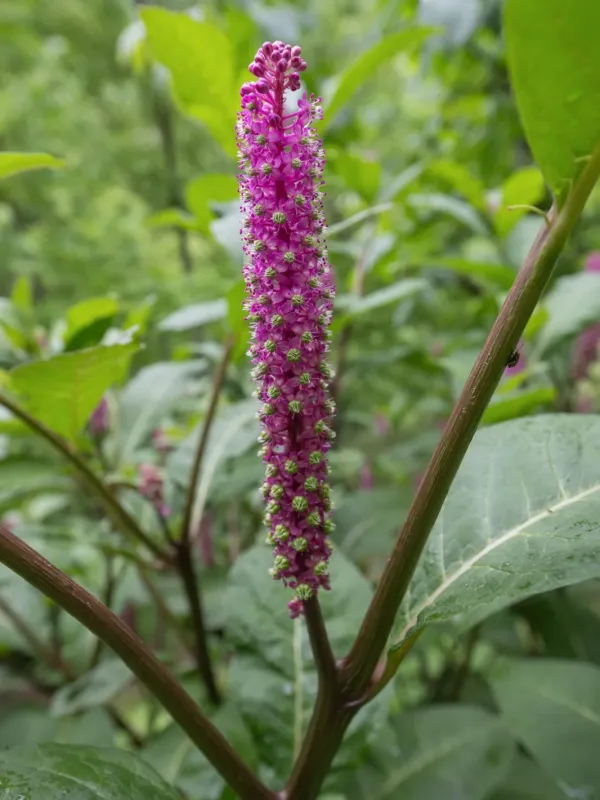
Description
How to tell it apart
Phytolacca polyandra, commonly known as the many-stamened pokeweed, is a perennial herbaceous plant belonging to the Phytolaccaceae family. It is characterized by a thick, fleshy taproot system.
The plant grows tall, often reaching heights of 1.5 to 2 meters with erect, smooth stems. The leaves are large, simple, and alternate, typically lanceolate or elliptical in shape.
Its inflorescences are dense, raceme-like clusters located at the tips of the shoots. The small, greenish-white flowers eventually ripen into dark purple or black berry-like fruits.
All parts of the plant are considered toxic, containing saponins and alkaloids that can be harmful if ingested by humans or livestock.
As a perennial weed, it is biologically programmed for persistence, with the ability to sprout repeatedly from its deep and energetic rootstocks.
Where it grows
This species thrives in nutrient-rich, moist soils. It is frequently found in woodland edges, along riverbanks, and in neglected rural or urban landscapes.
In agricultural settings, it often becomes a nuisance in orchards, vineyards, and perennial crop fields, where it can quickly establish itself between crop rows.
It frequently colonizes field margins and buffer zones, slowly encroaching into cultivated areas and creating dense patches that outcompete native or planted species.
Birds play a significant role in its dispersal by consuming the fleshy berries and spreading the seeds across wide areas, making it difficult to contain outbreaks.
The plant demonstrates high ecological plasticity, allowing it to adapt to various moisture regimes, although it strongly prefers sites with deep, organic-rich soil.
Harm it causes
The primary agricultural harm caused by Phytolacca polyandra is competition for soil moisture and nutrients, which significantly suppresses the growth of adjacent crops.
The plant exhibits allelopathic traits, releasing biochemicals into the soil that inhibit the germination and development of other plant species nearby.
Its toxicity poses a severe risk to livestock. If the weed is accidentally harvested with hay or silage, it can cause severe poisoning in cattle and other animals.
The sheer size and dense foliage of the plant create shading problems, reducing the photosynthetic efficiency of neighboring crops and limiting their yield.
Additionally, the weed complicates mechanical harvesting and field maintenance, often requiring labor-intensive cleanup and potential filtering of contaminated harvests.
How to control
Mechanical control focuses on deep cultivation and the physical removal of the rootstock, as shallow tillage often fails to prevent re-growth.
Frequent mowing is essential to prevent the plant from reaching the fruiting stage, thereby breaking the cycle of seed dispersal by birds.
Chemical control is most effective using systemic, non-selective herbicides applied during the active growth phase, allowing the chemical to reach the deep roots.
In orchard settings, spot-treatment or stem injection techniques are recommended to manage the weed without harming sensitive crop species.
- Deep plowing and soil inversion.
- Manual extraction of rhizomes in small infestations.
- Application of systemic herbicides during the budding stage.
- Monitoring and maintenance of field perimeters to prevent spread.
Taxonomy
- Latin name
- Phytolacca polyandra
- Family
- Лаконос
- EPPO code
- PHTPO