
Pokeweed (Phytolacca octandra)
Phytolacca octandra
Description
How to tell it apart
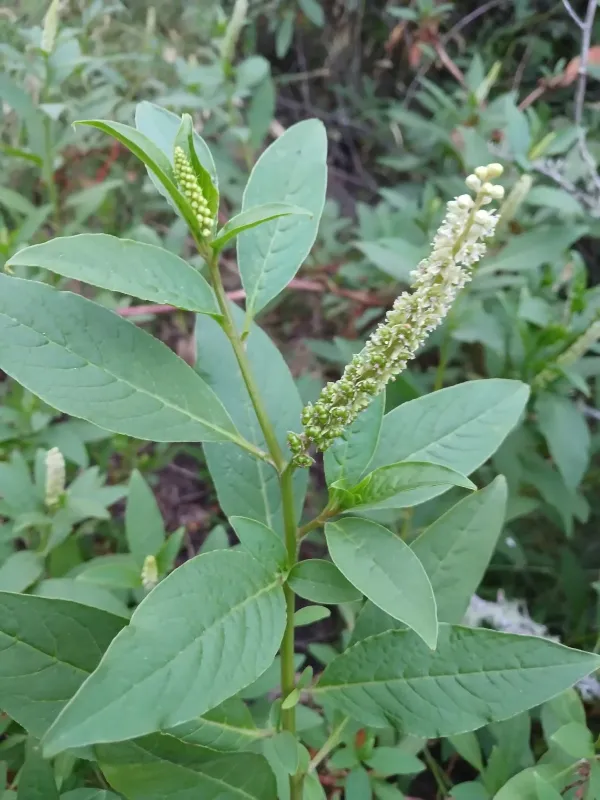
Phytolacca octandra, commonly known as a species of pokeweed, is a perennial herbaceous plant belonging to the Phytolaccaceae family. It is characterized by a thick, fleshy taproot that provides great resilience.
The plant features upright, branched stems that can grow quite tall. Its leaves are alternate, entire, and have an elliptical shape, often appearing a deep, vibrant green.
The flowers are small and arranged in dense racemes. The most distinctive feature is the fruit, which consists of dark, juicy berries containing numerous seeds that remain viable in the soil for years.
Every part of the plant contains toxic compounds. This toxicity is a significant factor in its classification as a nuisance in both agricultural and natural settings.
The plant has a strong ability to regenerate from its root system, meaning that simple cutting or mowing often leads to rapid regrowth if the roots remain intact.
Where it grows
This weed thrives in fertile, well-irrigated soils. It is frequently found in cultivated fields, including row crops, vineyards, and orchards where the growing conditions are favorable.
Phytolacca octandra is adapted to warmer climates and is often seen along field edges, fence lines, and areas with disturbed, nutrient-rich soil.
The seeds are easily disseminated by birds that consume the dark berries. This natural method of dispersal allows the weed to colonize new fields and pastures quite rapidly.
It acts as an opportunistic colonizer in areas where competition is low or where soil disturbance has occurred due to agricultural machinery.
In neglected fields, it can quickly become the dominant plant species, forming dense stands that effectively choke out other vegetation.
Harm it causes
The primary agricultural impact of this plant is its competition with crops for water, light, and nutrients. Because of its vigorous growth, it can easily suppress younger, more sensitive crop plants.
The presence of tall, woody stems interferes with mechanized harvesting and tillage operations. This can lead to increased costs and reduced efficiency during critical periods.
Since the plant is toxic, it poses a danger to livestock. If contaminated forage is consumed by animals, it can lead to severe health issues, making the presence of this weed a liability.
The long-lived seed bank that Phytolacca octandra creates means that infestation is not just a single-season problem but requires a long-term management strategy to eradicate.
The plant can also host a variety of pathogens and insect pests that may cross-infect desirable crops, adding to the total economic loss for the farmer.
How to control
Successful management begins with cultural practices, such as deep plowing to damage the root systems and inhibit germination of dormant seeds.
Manual removal is effective for isolated patches, provided the entire root system is extracted. It is crucial to perform this before the plant produces fruit to prevent further spreading.
Chemical control usually involves systemic herbicides. Because of the deep taproot, spot treatment with broad-spectrum herbicides is often necessary for complete control.
In-crop management should focus on early-season control using appropriate selective herbicides, tailored to the specific crop stage to avoid injury to the desired plants.
- Deep tillage for root system exhaustion.
- Removal before seed production to deplete the seed bank.
- Systemic herbicide application during active growth stages.
- Strategic crop rotation to break the weed's lifecycle.
Taxonomy
- Latin name
- Phytolacca octandra
- Family
- Лаконос
- EPPO code
- PHTOC