
Mexican pokeweed
Phytolacca heterotepala
Description
How to tell it apart
Mexican pokeweed (Phytolacca heterotepala) is a perennial herbaceous plant belonging to the Phytolaccaceae family. It is characterized by a thick, fleshy root system that provides strong survival capabilities.
The plant features sturdy, upright stems that can grow quite tall. The leaves are large, entire, and alternate, typically elliptical or lanceolate in shape.
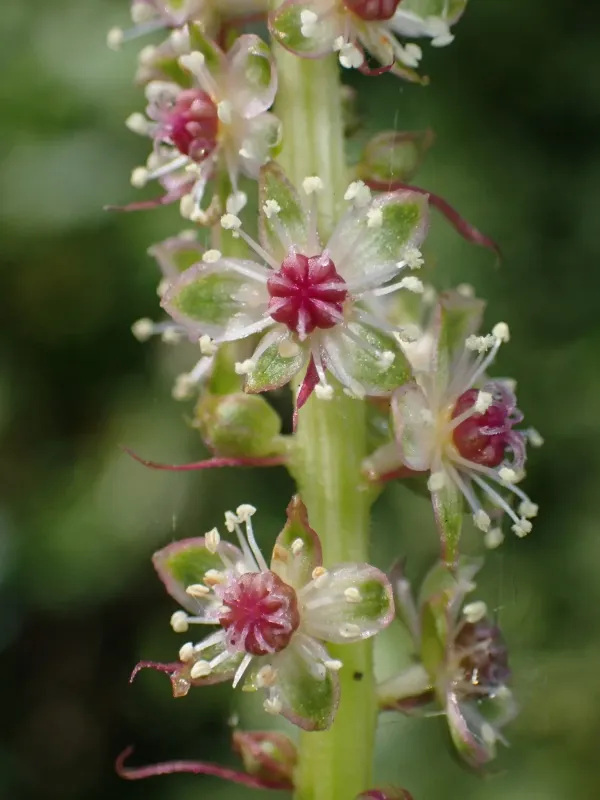
It produces dense terminal racemes of small, greenish-white flowers. A distinct botanical feature is the perianth, which remains persistent as the plant sets its fruit.
The fruits are succulent, nearly black berries arranged in drooping clusters. Each berry contains several small, resilient seeds that can remain viable in the soil for extended periods.
All parts of the plant are considered toxic to animals and humans due to the presence of saponins and phytolaccatoxin, which serve as a natural defense mechanism.
Where it grows
Mexican pokeweed thrives in moist, nutrient-rich soils and is often found in disturbed areas such as roadsides, field margins, and abandoned agricultural lands.
It is an invasive species that easily infiltrates row crops. Its ability to colonize new territories is supported by birds that distribute the seeds after consuming the berries.
The plant prefers sunny environments with sufficient moisture, making it a common sight in lowland fields or near irrigation ditches where competition is intense.
Once established, the plant becomes difficult to eradicate due to its deep taproot, which allows it to persist even in drought conditions or poor management cycles.
Agricultural machinery is a primary vector for spreading the plant's vegetative parts and seeds across large areas during standard cultivation and harvesting operations.
Harm it causes
Mexican pokeweed is highly competitive, severely limiting the growth and yield of crops by outcompeting them for light, water, and essential mineral nutrients.
The rapid development of its vegetative mass creates shade, inhibiting the photosynthesis of surrounding crop seedlings and leading to reduced stand density.
The plant's toxicity is a serious concern for feed safety. If berries are harvested along with the main crop, they can contaminate the yield and reduce its quality for industrial or feed use.
Physical interference with machinery is another major harm, as the succulent stems can clog harvest equipment, leading to downtime and increased maintenance costs.
Furthermore, it acts as an alternative host for various agricultural pests and pathogens, complicating pest management programs and increasing the need for additional chemical treatments.
How to control
Effective management requires a multi-year approach, focusing on destroying the root system and preventing seed production through consistent monitoring and timely intervention.
Mechanical control involves deep tillage and complete extraction of the root system. Partial removal is ineffective, as the plant regenerates from any remaining root fragments.
Chemical control is most effective using systemic, non-selective herbicides applied to actively growing plants before the fruit matures to ensure deep translocation into the roots.
In-crop management utilizes selective herbicides tailored to the specific crop, although repeat applications are often necessary due to the plant's resilience.
- Monitor field boundaries to prevent encroachment.
- Hand-pull young plants before root systems develop.
- Clean machinery thoroughly between field shifts.
- Use cover crops to suppress seedling emergence.
Taxonomy
- Latin name
- Phytolacca heterotepala
- Family
- Лаконос
- EPPO code
- PHTHT