
American pokeweed
Phytolacca americana
Description
How to tell it apart
American pokeweed (Phytolacca americana) belongs to the Phytolaccaceae family. It is a perennial herbaceous plant featuring a massive, fleshy taproot that penetrates deep into the soil.
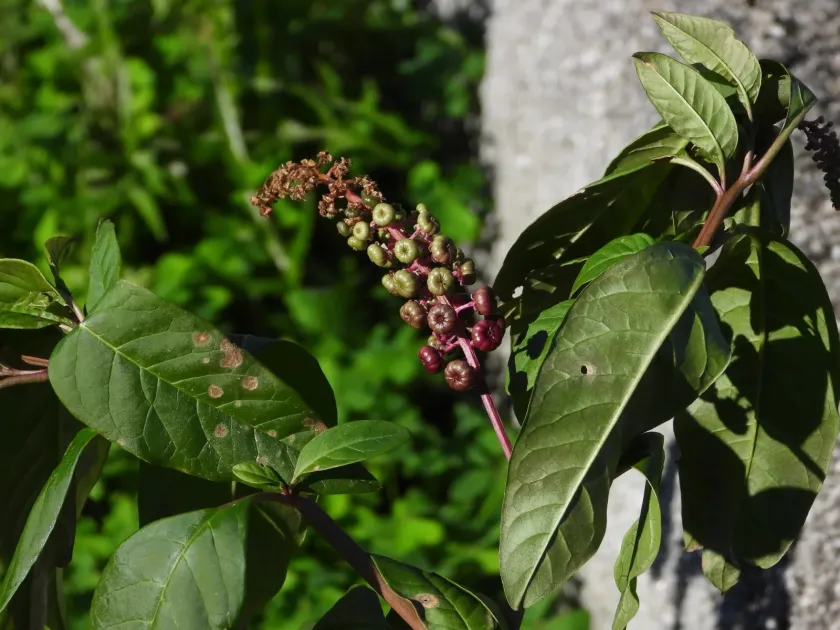
The stems are erect, frequently showing a reddish tint, and can reach heights of 2-3 meters. Leaves are large, alternate, and ovate-lanceolate, tapering to a point at both ends.
Flowers are small, white or greenish, arranged in dense, candle-like racemes. Flowering typically begins in mid-summer, creating a distinct visual marker for the plant.
The fruits are juicy, dark purple to black berries held in drooping clusters. Each berry contains up to 10 seeds, which remain viable in the soil for several years.
It is crucial to note that all parts of this plant contain toxic compounds, specifically phytolaccatoxin. Always wear protective gloves and gear when handling the plant.
Where it grows
This weed favors rich, loose, and moist soils. It is commonly found in gardens, vegetable patches, along forest edges, and on abandoned agricultural lands.
In agriculture, it presents a significant challenge in row crops, nurseries, and areas with perennial plantings where mechanical cultivation is difficult to execute.
Pokeweed aggressively colonizes open areas due to its rapid growth rate and its ability to outcompete other flora using its robust and expansive root system.
The plant is well-adapted to partial shade, which allows it to thrive on forest margins and invade adjacent agroecosystems as a persistent and resilient weed species.
Seed dispersal is primarily facilitated by birds that consume the berries, making it extremely difficult to eradicate the plant from a single site without regional management.
Harm it causes
The primary damage caused by pokeweed is the suppression of desired crops, as its large root system aggressively absorbs moisture and nutrients from deep soil layers.
The plant's massive physical stature shades out smaller crops, leading to stunted growth, reduced photosynthesis, and significant declines in overall agricultural yields.
Due to the toxic nature of its sap, accidental contamination of forage or hay crops can lead to poisoning in livestock, posing a serious safety concern for farmers.
Pokeweed often serves as an alternative host for various crop pests and pathogens, increasing the overall disease pressure within a farm or garden setting.
High vegetative regeneration from root fragments requires intensive labor and long-term investment to fully reclaim infested acreage from this invasive species.
How to control
Mechanical removal is the first line of defense; however, it is only effective if the entire root system is extracted, as even small fragments can easily resprout.
Systematic deep plowing or hand-digging, followed by the thorough removal of root crowns over several seasons, helps exhaust the plant's stored nutrient reserves.
Chemical control involves the use of systemic non-selective herbicides, such as those containing glyphosate, applied directly to the foliage during the active growth stage.
Efficiency can be improved by using targeted application methods, such as brush-on treatments, to ensure the herbicide reaches the roots while protecting nearby non-target crops.
- Monitor fields consistently before the fruiting phase begins.
- Eradicate seedlings as soon as they emerge during the spring.
- Apply systemic herbicides during calm weather in the evening.
- Establish competitive cover crops to suppress pokeweed establishment.
Taxonomy
- Latin name
- Phytolacca americana
- Family
- Лаконос
- EPPO code
- PHTAM