
American pokeweed
Phytolacca
Description
How to tell it apart
American pokeweed (Phytolacca americana) is a large herbaceous perennial belonging to the Phytolaccaceae family. It can reach heights of up to 2 meters or more.
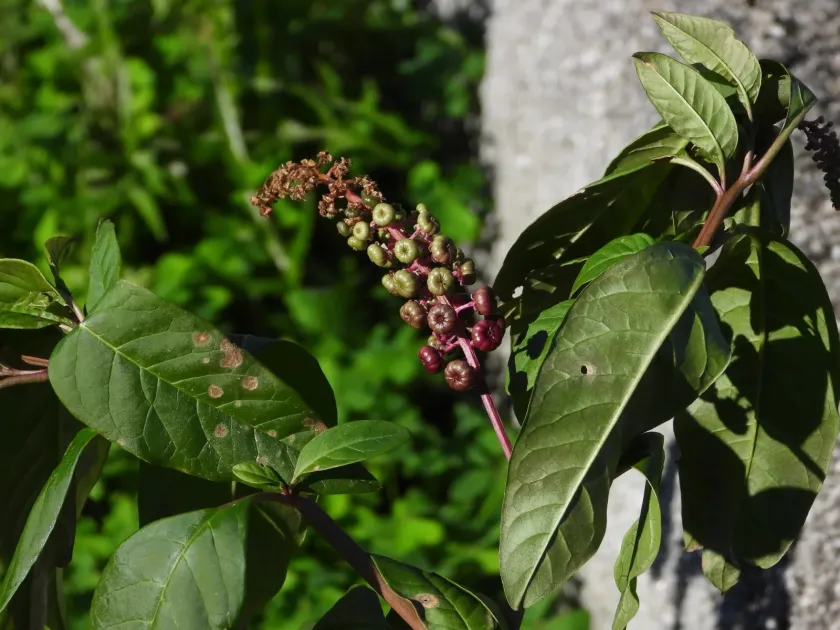
The plant has a smooth, thick stem that often develops a reddish or purplish color as it matures. The leaves are large, entire, and alternate with pointed tips.
The root system is a large, fleshy, white taproot that can grow deep into the soil, making the plant extremely resilient to physical damage and environmental stress.
It produces racemes of small, white-to-greenish flowers which eventually turn into dark purple or black berries. These berries are toxic to humans and many animals.
All parts of the pokeweed plant contain potent compounds that can cause skin irritation, so protective clothing is necessary when handling or removing it.
Where it grows
Pokeweed thrives in moist, fertile soils, often found in pastures, forest clearings, disturbed sites, and roadsides where it can compete for space.
The weed is highly adaptable and frequently invades agricultural fields, orchards, and vineyards if not kept under control by regular maintenance.
Birds play a significant role in spreading the seeds of the plant. By consuming the berries, they deposit seeds in new locations far from the original plant.
It prefers areas with abundant sunlight but can tolerate partial shade, allowing it to colonize diverse environments, including fence lines and abandoned lots.
The plant's ability to establish quickly in disturbed soil makes it a common invader of areas following agricultural field preparation or construction activity.
Harm it causes
The primary concern with pokeweed is its toxicity. It poses a significant danger to livestock, as ingestion of leaves or berries can lead to severe poisoning.
As a weed, it is a strong competitor for nutrients and water, directly reducing the yields of crops grown in the same area due to its massive root system.
The sheer size of mature pokeweed plants creates heavy shading, which suppresses the growth of neighboring crops and restricts their access to essential sunlight.
The long-term persistence of its seeds in the soil means that once a patch is established, it can remain a persistent problem for many growing seasons.
Its deep, tough root structure can impede agricultural machinery and make soil cultivation difficult, often requiring extra passes or heavier equipment to clear.
How to control
Mechanical removal is challenging because leaving any piece of the root in the ground will allow the plant to regenerate rapidly from dormant buds.
Manual digging must be thorough, ensuring the entire taproot is removed from the soil. Simply cutting the plant at ground level will not provide long-term results.
Chemical control using systemic herbicides is the most effective approach for large infestations. These herbicides should be applied during the plant's active growth stage.
Preventing the plant from setting seed is vital. Cutting off the flowering racemes early in the season will stop the spread of new seeds across the farm.
- Deep cultivation to disrupt root growth
- Systemic herbicide application (glyphosate)
- Manual removal of young plants
- Early detection and monitoring programs
Taxonomy
- Latin name
- Phytolacca
- Family
- Лаконос
- EPPO code
- PHTSS