
Garlicweed
Petiveria alliacea
Description
How to tell it apart
Garlicweed (Petiveria alliacea) is a perennial herbaceous plant belonging to the Phytolaccaceae family. It typically grows as an erect shrub with thin, slender branches, reaching heights of up to one meter.
The leaves are alternate, simple, and elliptic to lanceolate in shape with entire margins. The root system is characterized by a strong, woody taproot, which grants the plant high resilience in various soil environments.
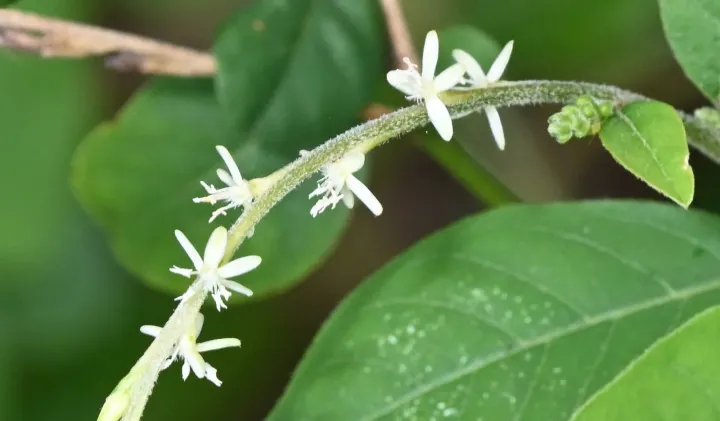
Its flowers are small, greenish-white or pinkish, and arranged in long, terminal or axillary racemes. After flowering, the plant produces drupe-like fruits equipped with hooked, barbed bristles.
The plant's most distinct feature is the pungent, garlic-like odor released when any part of the plant is crushed. This scent is attributed to the presence of sulfur-containing compounds.
Reproduction is primarily through seeds, which are efficiently dispersed by animals and human activity due to their hooked attachments. Vegetative propagation can also occur if the rootstock is damaged.
Where it grows
The natural habitat of garlicweed includes tropical and subtropical regions of the Americas, specifically spanning from the United States (Florida and Texas) through Mexico, the Caribbean, and South America.
As an introduced species, it has successfully established populations in parts of India, Sri Lanka, Java (Malesia), and regions of Africa, including Benin and South Africa.
In agricultural settings, it commonly invades pastures, fallow fields, and perennial plantations. It is highly adaptable and thrives in disturbed, moist, and shaded environments.
Garlicweed is frequently found along roadsides, field boundaries, and near residential areas, from which it rapidly expands into productive crop land.
The plant poses a significant risk to reduced-tillage areas, where it can quickly dominate the vegetation and form dense, persistent stands that outcompete native or planted species.
Harm it causes
The primary harm caused by garlicweed is its aggressive competition with crops for sunlight, water, and essential soil nutrients, leading to reduced agricultural yields.
In pastures, garlicweed is particularly problematic for livestock. When ingested by dairy cows, the plant's volatile compounds cause the meat and milk to develop a foul, garlic-like off-flavor, significantly devaluing the farm produce.
Dense thickets of garlicweed create physical barriers that hinder the movement of agricultural machinery and make routine field management tasks difficult and labor-intensive.
Furthermore, garlicweed serves as a reservoir for various plant pests and diseases, providing a breeding ground that can lead to outbreaks in economically valuable crops.
Through the release of allelopathic compounds, the plant can suppress the growth and germination of surrounding plants, maintaining its dominance over an area once established.
How to control
Cultural control methods involve deep plowing or tillage, specifically designed to expose and destroy the deep taproot system. Repeated mechanical disturbance is necessary to deplete the root's energy reserves.
Manual removal is effective only if the entire root system is extracted. Leaving even small pieces of the root in the soil can lead to rapid regrowth, making this method labor-heavy.
To curb the spread, mowing should be performed before the plant reaches the seeding stage. Ensuring the purity of crop seeds and preventing the movement of soil from infested areas are also essential preventive measures.
Chemical control utilizing systemic herbicides is often required for large-scale infestations. Products containing glyphosate are effective when applied to actively growing foliage during the vegetative stage.
An integrated approach, combining herbicide application with post-treatment mechanical cultivation, provides the most reliable long-term strategy for eradicating established garlicweed populations.
Taxonomy
- Latin name
- Petiveria alliacea
- Family
- Лаконос
- EPPO code
- PEVAL