
Striga gesnerioides
Striga gesnerioides
Description
How to tell it apart
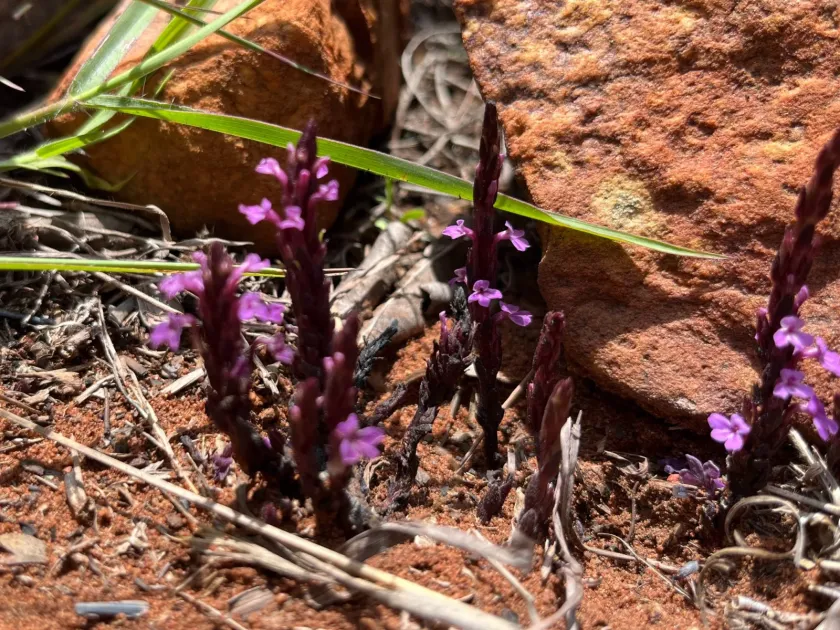
Striga gesnerioides, commonly known as witchweed, is an obligate root parasite belonging to the family Orobanchaceae. The plant appears as an erect, herbaceous stem, reaching 10 to 30 centimeters in height, and is characteristically devoid of chlorophyll.
The stems of this weed are usually branched and covered with tiny, scale-like leaves. The plant exhibits colors ranging from pale yellow to reddish-purple, making it easily distinguishable during its flowering stage against the backdrop of crop fields.
The flowers of Striga gesnerioides are small, tubular, and arranged in terminal spike-like inflorescences. Their color spectrum spans from lavender and lilac to almost white, serving as a critical morphological marker for field identification.
The root system of the plant is modified into haustoria, specialized organs designed for attachment and penetration. Through these organs, the parasite establishes a vascular connection with the host plant to extract water, mineral nutrients, and photosynthates.
The fruit develops as a capsule containing a vast quantity of dust-like seeds. A single plant can produce several hundred thousand seeds, which remain viable in the soil for 15–20 years, waiting for the chemical cues from a suitable host to germinate.
Where it grows
The primary distribution range of Striga gesnerioides encompasses the tropical and subtropical regions of Africa, as well as parts of Asia and the Arabian Peninsula. It is rarely found in temperate or cooler climatic zones due to its heat-dependent germination requirements.
The weed specializes in infecting a broad range of agricultural crops, with cowpea (Vigna unguiculata) being one of its most economically important hosts. Other susceptible hosts include tobacco, sweet potato, and various wild leguminous species.
For germination, seeds of Striga gesnerioides require specific chemical signals, known as strigolactones, secreted by host roots into the rhizosphere. Without these signals, the seeds remain dormant, even under ideal soil moisture and temperature conditions.
The parasite thrives in poor, nutrient-deficient soils, particularly those low in nitrogen and phosphorus. The intensity of infestation is directly linked to soil fertility; weaker, nutrient-stressed host plants are significantly more susceptible to haustorial penetration.
In arid climates, Striga gesnerioides becomes exceptionally aggressive. Beyond the direct extraction of nutrients, it severely disrupts the host's water balance, frequently leading to premature wilting and crop failure during the critical stages of plant development.
Harm it causes
The harm caused by Striga gesnerioides lies in its massive depletion of host plant resources. The parasite begins draining nutrients long before its aerial shoots emerge from the soil, which significantly complicates early detection and management efforts.
Infected crops exhibit stunted growth, leaf chlorosis, and a substantial decline in yield. Common physiological impacts include the deformation of reproductive organs, which leads to a near-total cessation of pod and seed formation in affected legumes.
Crop losses in heavily infested fields can range from 80% to 100%. The economic significance of this parasite is so profound that in endemic areas, large tracts of farmland become virtually unusable for the cultivation of susceptible species.
In addition to nutrient theft, Striga gesnerioides induces hormonal imbalances in the host's root system. This stress reduces the plant's overall resilience to environmental factors, such as high heat and drought, effectively amplifying the damage caused by the parasite.
The rapid dispersal of seeds via wind, water, and agricultural equipment facilitates the colonization of new fields. The presence of a massive, long-lived soil seed bank makes this weed one of the most persistent and challenging threats in tropical agriculture.
How to control
Agronomic control involves strict crop rotation schemes utilizing trap crops, such as cotton or sorghum, which stimulate the germination of Striga seeds but do not allow the parasite to attach, effectively depleting the soil seed bank over time.
The development and deployment of resistant or tolerant crop varieties remain the most effective protection strategies. Breeding programs focus on host plants that either produce low levels of strigolactones or have physical barriers preventing haustorial entry.
Chemical control is complicated by the parasite's underground biology. Systemic herbicide applications can be utilized, but precision timing is essential: treatments must occur before the parasite successfully penetrates the host's vascular system.
Integrated pest management (IPM) incorporates deep tillage to bury seeds beyond the effective range of host signals, alongside balanced fertilization to improve host vigor and resilience against initial infection by the parasite.
Biological control research, focusing on specialized myco-parasitic fungi or host-specific phytophagous insects, is ongoing. These methods hold potential for sustainable population reduction of Striga without relying on heavy chemical pesticide usage.
Taxonomy
- Latin name
- Striga gesnerioides
- Family
- Заразиха
- EPPO code
- STRGE