
Striga angustifolia
Striga angustifolia
Description
How to tell it apart
Striga angustifolia, commonly known as witchweed, is a parasitic plant in the Orobanchaceae family. Unlike total parasites, it is a hemiparasite, meaning it can perform photosynthesis but still requires a host for water and minerals.
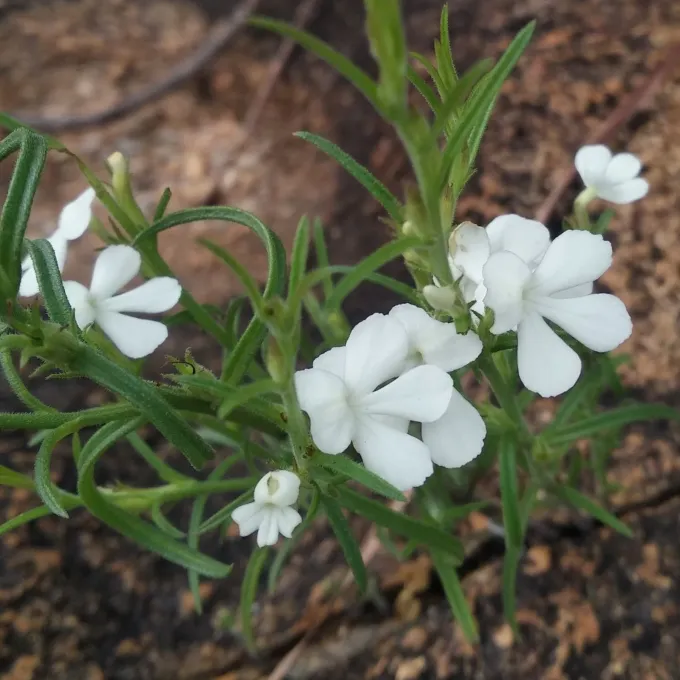
The plant grows as an erect herb, reaching heights of 15 to 40 cm. The stem is often branched, providing a structural foundation for its narrow, linear, and opposite leaves that characterize this specific species.
Its flowers are relatively small, typically white or pale pink, appearing in the leaf axils along the upper part of the stem. The floral morphology is distinctive, featuring a tubular structure common to the Striga genus.
The root system is the most significant part for identification purposes, as it is modified into haustoria. These structures attach directly to the host plant's roots to extract water and essential nutrients.
The plant produces thousands of microscopic seeds, which are highly resilient. These seeds are easily dispersed by wind, water, and farming equipment, allowing the parasite to spread over vast areas.
Where it grows
Striga angustifolia is primarily distributed across tropical and subtropical regions of Asia, with significant prevalence in countries like India and China where cereal farming is dominant.
The weed thrives in warm, well-lit environments and is particularly aggressive in soils that are low in fertility or have poor nitrogen content. It prefers habitats where host crops are cultivated continuously.
It occupies agricultural fields, specifically targeting cereals like rice, sorghum, and millet. It can also persist in wild grasslands, waiting for suitable hosts to be planted nearby.
The parasite is highly adapted to areas with alternating wet and dry seasons. The soil moisture levels play a critical role in the germination process of the Striga seeds.
Invasion of new fields is often facilitated by human activities, including the movement of contaminated soil on farm machinery and the use of poorly cleaned crop seeds containing Striga as an impurity.
Harm it causes
The harm caused by Striga angustifolia is severe, as it competes directly with crops for nutrients and moisture. This leads to substantial stunting and chlorosis in the host plants.
Infected crops exhibit significant yield losses, often ranging from 30% to over 80%. In extreme cases of heavy infestation, the entire crop yield can be lost entirely if not managed correctly.
The parasite starts its damaging effect while still underground, draining the host of its photosynthetic products before the weed is even visible to the farmer.
In addition to nutrient depletion, Striga interferes with the host's hormonal signaling, disrupting normal growth patterns and leading to poor flower and grain development.
Crops infested with Striga appear dehydrated even when soil moisture is adequate, as the parasite effectively intercepts the water flow intended for the crop's vascular system.
How to control
Managing Striga requires an integrated pest management (IPM) approach. A key strategy is the use of non-host crops in a rotation to break the parasite's life cycle effectively.
Trap cropping is highly effective, where crops are grown that stimulate Striga seeds to germinate but do not allow the parasite to attach, thus exhausting the soil seed bank.
Physical control measures include deep plowing to uproot the weed before it flowers. Hand-pulling is feasible only if performed before the plant produces its numerous seeds.
Chemical control focuses on the use of herbicides, although the success rate varies depending on the timing of application and the growth stage of the parasitic weed.
Strict phytosanitary practices are essential, including thorough cleaning of agricultural machinery between fields to prevent the unintentional transfer of microscopic seeds to uninfected areas.
Taxonomy
- Latin name
- Striga angustifolia
- Family
- Заразиховые
- EPPO code
- STRAN