
Yellow rattle
Rhinanthus minor
Description
How to tell it apart
Yellow rattle (Rhinanthus minor) is an annual hemiparasitic plant belonging to the Orobanchaceae family, typically growing to a height of 10–50 cm.
The plant features opposite, lanceolate leaves with serrated margins, and its stem is often characterized by dark spots or stripes along its length.
The flowers are yellow and organized in a spike-like inflorescence, with inflated calyces that are often hairless or only slightly pubescent.
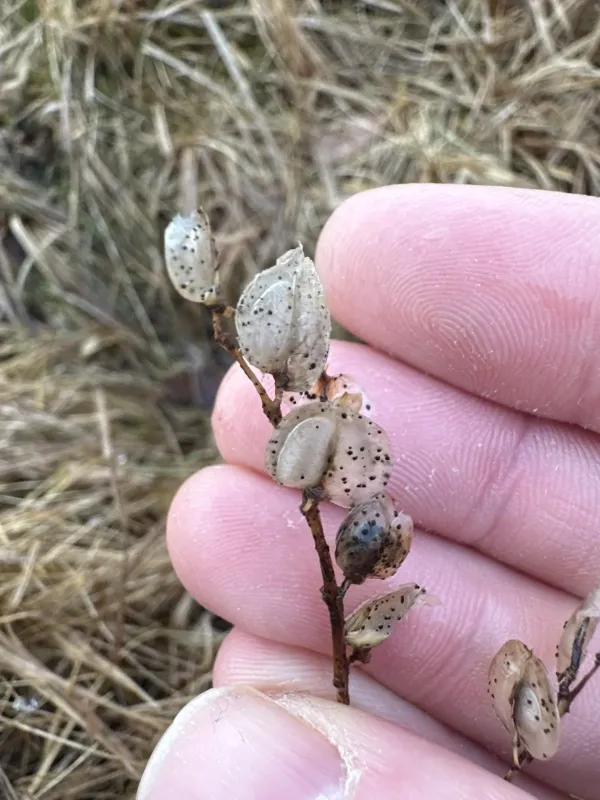
It gets its common name from the sound that dry, ripe seeds make when they rattle inside the papery, bladder-like seed capsules in late summer.
Its root system is equipped with haustoria, which are specialized structures that penetrate the roots of host plants to extract water and nutrients.
Where it grows
Yellow rattle is commonly found in grasslands, meadows, pastures, and along the edges of fields, preferring damp and nutrient-poor soil conditions.
In agricultural settings, it frequently appears in areas seeded with perennial legumes, where the lack of vigorous competition allows it to thrive.
It prefers habitats that are not heavily fertilized, as nitrogen-rich soils generally discourage its growth, making it a natural colonizer of neglected land.
The plant is highly adaptive and can spread across various temperate regions, often becoming a significant issue in fields where mechanical tillage is limited.
Distribution is primarily achieved through seed dispersal, which can be accelerated by contaminated fodder or machinery moving between agricultural sites.
Harm it causes
The primary harm caused by Yellow rattle is its parasitic lifestyle, as it actively siphons nutrients and water from the root systems of host plants.
This parasitic activity significantly reduces the biomass and yields of agricultural crops, particularly affecting the vitality of clover and alfalfa fields.
In meadow ecosystems, an infestation of Yellow rattle can outcompete desirable grasses and wildflowers, leading to a decline in overall biodiversity and forage quality.
The presence of this weed can lead to the thinning of dense swards, leaving the ground vulnerable to the invasion of other, more aggressive weed species.
Furthermore, because it is an annual that reproduces solely by seed, a single infestation can build up a significant soil seed bank that lasts for several years.
How to control
The most effective strategy for managing Yellow rattle is preventing the plant from setting seed, which can be achieved through timely mowing and grazing.
Mowing the infested areas before the seeds mature is crucial to exhausting the seed bank and preventing the weed from proliferating in the following season.
Cultivation practices such as deep ploughing can bury the seeds to a depth where they will not germinate, effectively breaking the cycle of re-infestation.
While chemical control is possible with certain herbicides, it must be performed with caution to avoid damaging the beneficial species within the crop stand.
- Early mowing before seeds are fully developed.
- Avoid spreading contaminated hay on agricultural land.
- Deep tillage in fields designated for reseeding.
- Targeted herbicide application in early growth stages.
- Managing soil nutrient levels to improve crop competition.
Taxonomy
- Latin name
- Rhinanthus minor
- Family
- Заразиха
- EPPO code
- RHIMI