
Parentucellia latifolia
Parentucellia latifolia
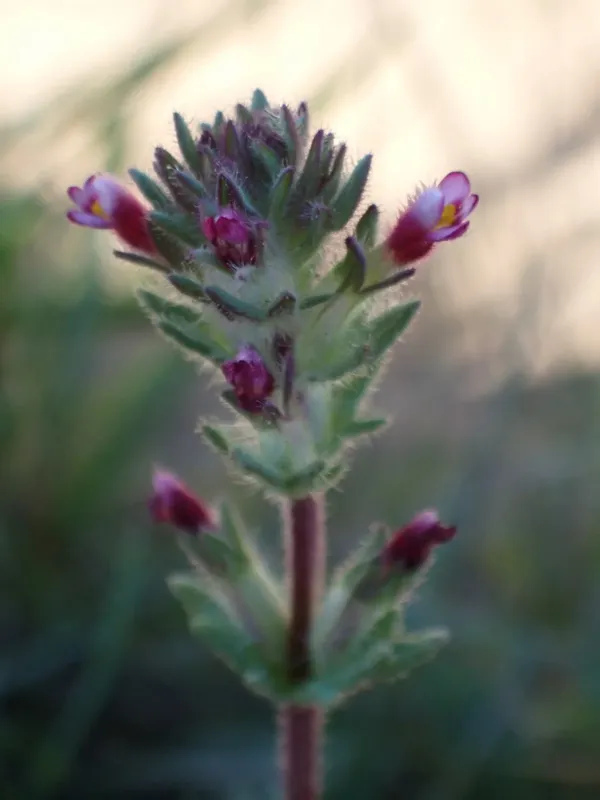
Description
How to tell it apart
Parentucellia latifolia is an annual herbaceous plant belonging to the Orobanchaceae family. It was formerly classified within the Scrophulariaceae family.
The plant typically grows to a height of 5 to 30 centimeters. Its stem is erect, covered with fine, glandular hairs which give it a distinctive texture when touched.
The leaves are opposite, ovate in shape, and feature serrated edges. Despite being green and capable of photosynthesis, the plant relies on supplemental resources from host plants.
The flowers are arranged in a dense terminal raceme. Each flower has a two-lipped corolla, often displaying a vibrant yellow or purplish hue, which makes it easy to spot in the field.
The root system is unique because it forms haustoria — specialized structures that attach to the roots of other plants to draw water and nutrients.
Where it grows
This weed prefers open, sunny environments. It is frequently found in pastures, meadows, along roadsides, and on abandoned agricultural lands.
Originating from the Mediterranean region, it has expanded its range across parts of Southern Europe, Northern Africa, and Western Asia, becoming a nuisance in similar climates.
In agricultural settings, it commonly infests winter cereal crops and forage fields, as the high density of host roots provides ideal conditions for the parasite to thrive.
It prefers moist, well-drained soils and is sensitive to extreme conditions, often flourishing in areas where vegetation cover has been disturbed or overgrazed.
Seed dispersal is highly efficient, occurring primarily through wind, water runoff, and movement of farm machinery, which facilitates its spread across large areas.
Harm it causes
As a facultative root hemiparasite, Parentucellia latifolia poses a significant threat by draining essential water and mineral nutrients from its host plants.
The direct impact on crops includes stunted growth, reduced biomass, and overall lower yield. Affected plants may struggle to reach their full potential during critical growing stages.
Host plants become increasingly vulnerable to drought conditions, as the parasite competes for limited moisture in the soil, exacerbating the stress on the crop.
In grazing lands, this weed acts as an invasive species that displaces valuable forage grasses, resulting in reduced pasture quality and lower nutritional value for livestock.
In severe infestations, the parasitic pressure leads to a sparse crop canopy, which leaves the soil exposed to further colonization by other opportunistic weed species.
How to control
Agronomic control strategies start with crop rotation, using non-host species to deplete the seed bank of the parasite in the soil over several growing seasons.
Deep tillage is a recommended cultural practice that disrupts the early growth of the weed and prevents the successful establishment of haustorial connections with crops.
Timely mowing of field margins and fallow areas before the weed begins to flower is essential to prevent the massive shedding of seeds back into the soil.
Chemical control involving systemic herbicides can be effective, though applications must be precisely timed for when the weed is most vulnerable to absorption.
Integrated pest management (IPM) is the most effective approach, combining preventive measures with targeted chemical applications to keep the weed population below economic thresholds.
Taxonomy
- Latin name
- Parentucellia latifolia
- Family
- Заразиха
- EPPO code
- PATLA