
Orobanche elatior
Orobanche elatior
Description
How to tell it apart
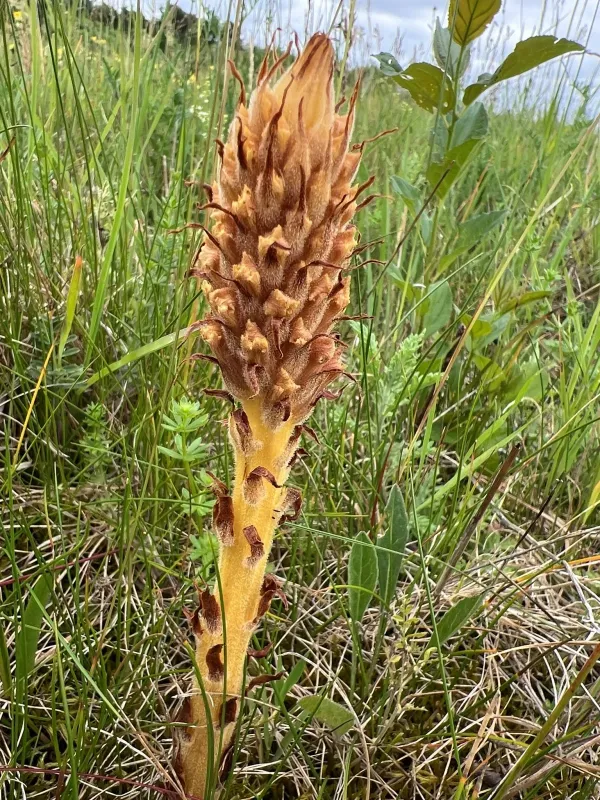
Orobanche elatior is a root parasitic plant belonging to the family Orobanchaceae, known for its lack of chlorophyll and dependence on host plants.
The plant typically grows as a fleshy, erect stem, reaching heights of 15 to 60 cm, with colors ranging from yellow to brownish-red.
Its inflorescence is a dense spike containing numerous tubular, bilabiate flowers, which vary in color from pale yellow to deep violet or blue.
It lacks a functional root system, instead utilizing haustoria to penetrate the host's roots and extract water and nutrients directly from the host's vascular system.
A single plant can produce tens of thousands of microscopic seeds, which are easily dispersed by wind, water, or agricultural machinery.
Where it grows
Orobanche elatior primarily parasitizes members of the Asteraceae family, often found on Centaurea scabiosa and other wild meadow plants in steppes and disturbed areas.
In agricultural settings, it can potentially affect various crops if the soil contains the seeds of this parasite and suitable host plants are cultivated nearby.
The seeds of this species require chemical signals from the root exudates of a potential host to trigger germination in the soil.
It thrives in well-drained, sun-exposed habitats, including field edges, pastures, and roadsides, where it remains hidden until the flowering stage.
The longevity of seeds in the soil is remarkable, with viability often extending beyond a decade, making it a persistent threat to agricultural land.
Harm it causes
The primary impact of Orobanche elatior is the severe physiological stress it places on the host plant by diverting essential water and nutrients.
Infested plants exhibit stunted growth, reduced leaf area, and significantly lower yields compared to healthy crops in non-infested areas.
By siphoning off resources, the parasite weakens the host's natural defenses, making the crop more susceptible to secondary fungal and bacterial infections.
In cases of heavy infestation, the yield loss can be substantial, leading to poor seed quality and reduced oil content in susceptible varieties.
The presence of the weed also complicates farm management, as it necessitates additional cleaning of seeds and potential changes to cropping schedules.
How to control
Management strategy relies heavily on the use of resistant crop cultivars and integrated pest management practices to break the life cycle of the parasite.
Agricultural techniques include deep tillage to bury seeds beyond their germination range and rigorous control of alternative host weeds in the field.
Chemical control can be achieved through specific herbicide programs, such as the use of imidazolinones in resistant crop systems to eliminate the parasite.
Strict sanitation protocols for agricultural machinery are essential to prevent the cross-contamination of fields with parasite seeds.
- Crop rotation with non-host plant species.
- Usage of high-quality, certified, and cleaned seed lots.
- Hand-pulling of broomrape stems before they flower and set seed.
- Implementation of trap crops to stimulate seed germination without successful attachment.
Taxonomy
- Latin name
- Orobanche elatior
- Family
- Заразиха
- EPPO code
- ORAEL