
Fatoua villosa
Fatoua villosa
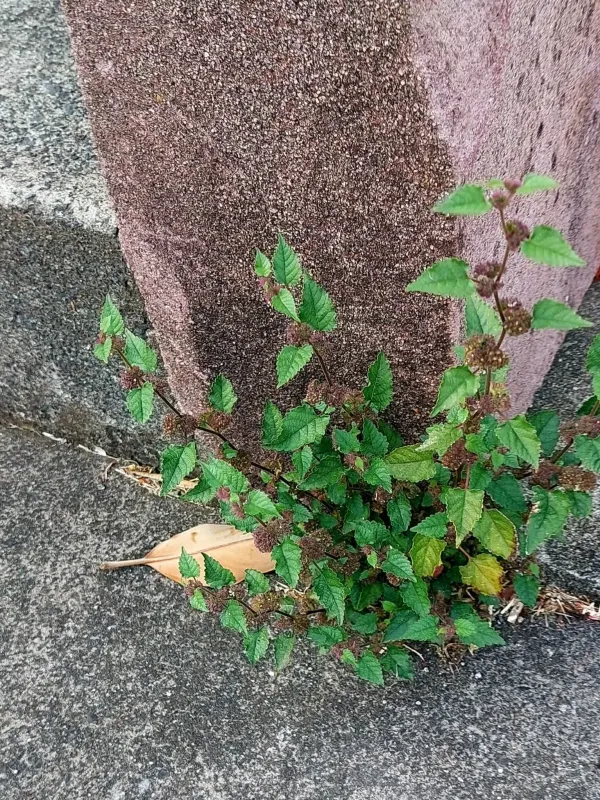
Description
How to tell it apart
Fatoua villosa, commonly known as hairy crabweed or mulberry weed, is an annual herb belonging to the Moraceae family. It is often mistaken for a stinging nettle due to its leaf shape, although it lacks stinging hairs.
The stems are erect or ascending, reaching heights between 20 and 80 centimeters. The leaves are alternate, ovate to elliptic in shape, with a pointed tip and serrated margins, covered in fine, soft hairs.
The inflorescences consist of small, dense, greenish-white clusters located in the leaf axils. The flowers themselves are monoecious and inconspicuous, making them easy to overlook during initial inspection.
The plant produces tiny achenes that exhibit explosive dehiscence. When ripe, the seeds are forcibly ejected from the fruit, allowing the plant to spread rapidly throughout a greenhouse or nursery area.
It possesses a fibrous root system that, while shallow, is highly efficient at colonizing containers and nursery pots, where it competes directly with ornamental plants for water and soil nutrients.
Where it grows
Native to East Asia, Fatoua villosa has become a widespread invasive species in many parts of the world, particularly in temperate and subtropical regions. It is primarily a pest of greenhouse environments.
This weed thrives in moist, shaded conditions, which is why it is commonly found in greenhouses, botanical gardens, shade houses, and nurseries. It adapts perfectly to artificial landscapes and potted plant setups.
Beyond controlled environments, it is found in damp soils, along riverbanks, in forest edges, and in shaded urban areas where irrigation is provided. It shows great resilience in human-altered habitats.
Its success in spreading is largely attributed to the global movement of containerized plants, where seeds often reside in the potting mix, remaining dormant until conditions favor their rapid germination.
Fatoua villosa does not tolerate extreme drought, so it is most prolific in locations with high humidity and consistent moisture, such as nursery benches that are regularly watered.
Harm it causes
The primary damage caused by Fatoua villosa is its aggressive competition with nursery crops. It can grow quickly, overshadowing young seedlings and consuming vital resources from the potting medium.
In commercial ornamental production, its presence often renders plants unmarketable. The sheer number of seeds produced by a single plant can quickly lead to an infestation across the entire nursery block.
Because the seeds are ejected explosively upon contact or maturity, standard weeding practices can actually increase the spread of the weed if not conducted with extreme caution and proper timing.
The weed can also harbor various pests and plant diseases, acting as an alternative host that complicates integrated pest management (IPM) programs within greenhouse production systems.
It has a short life cycle, meaning it can reach maturity and set seeds within a few weeks, leading to multiple generations of the weed within a single growing season.
How to control
Prevention is the most effective management strategy. This includes strict inspection of all incoming plant material and the use of sterile or heat-treated growing media to prevent the introduction of seeds.
Manual control involves removing the plants before they reach the reproductive stage. It is crucial to pull the plant from the roots while being careful not to disturb the seed heads to avoid seed dispersal.
Mulching the surface of pots with gravel, coarse sand, or landscape fabric can effectively block the light needed for germination, preventing the weed from establishing itself in containerized crops.
Chemical control is generally difficult within growing containers. Herbicides are best used for managing the weed on greenhouse floors, pathways, and perimeter areas to reduce the overall seed bank.
- Monitor growing areas frequently for seedling emergence.
- Remove plants early before fruit development.
- Apply mulch to prevent germination in pot surfaces.
Taxonomy
- Latin name
- Fatoua villosa
- Family
- Тутовые
- EPPO code
- FTOVI