
Caesarweed
Urena lobata
Description
How to tell it apart
Caesarweed (Urena lobata) is a robust shrubby herb belonging to the Malvaceae family. It can grow significantly tall, often reaching heights of two meters under favorable environmental conditions.
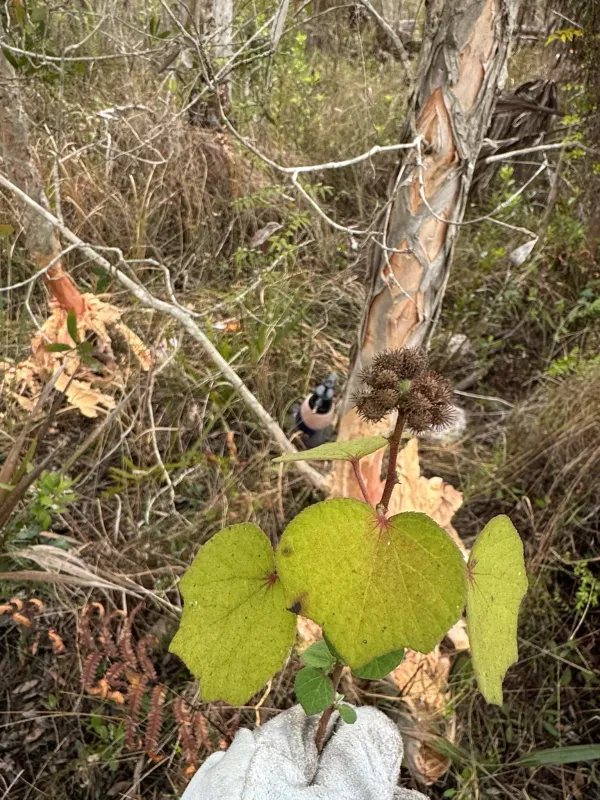
The leaves are distinctively lobed, often described as palmately lobed, with a grayish-white pubescence on the undersurface that aids in distinguishing it from other similar malvaceous weeds.
Flowers are typically small, pinkish to lavender with a darker center, blooming in the leaf axils. They are self-compatible, ensuring high reproductive success even when pollinators are sparse.
The fruit is a bur-like capsule covered in hooked spines. These hooks are specifically adapted to attach to fabrics, fur, and skin, facilitating wide-scale distribution of the plant seeds.
The root system is a deep taproot that allows the plant to persist in poor soil conditions and survive competitive environments where shallow-rooted species might fail.
Where it grows
Caesarweed thrives in tropical and subtropical regions across the globe, frequently invading agricultural landscapes, forest edges, and abandoned lands where ground has been disturbed.
It is particularly problematic in crop fields, including cotton and sugarcane, where it can rapidly establish dense thickets, displacing native vegetation and sensitive agricultural crops.
Harm it causes
As an aggressive weed, it causes direct competition for water, sunlight, and nutrients. Its rapid growth cycle allows it to overtop young seedlings, leading to significant yield loss.
Beyond physical interference, Caesarweed serves as an alternative host for various pests and diseases, such as the cotton leafworm and several species of nematodes, which threatens crop health.
How to control
Manual removal is effective for small infestations, provided it is done before the plant reaches the fruiting stage to prevent the accidental dispersal of the sticky bur-like seeds.
Mechanical cultivation, such as disking or plowing the field, is highly recommended to disrupt the root structure and bury seeds too deep for successful germination in the following seasons.
Chemical control involving systemic herbicides applied during the early vegetative growth stage has proven to be the most efficient strategy for large-scale infestations in commercial farming.
Integrated pest management (IPM) practices should be employed, focusing on maintaining healthy crop canopies that shade out potential weed seedlings and prevent them from thriving.
Continuous monitoring of field boundaries and irrigation channels is necessary, as these areas are common entry points for the introduction of seeds carried by water or farm equipment.
Taxonomy
- Latin name
- Urena lobata
- Family
- Мальвовые
- EPPO code
- URNLO