
Sida spinosa
Sida spinosa
Description
How to tell it apart
Sida spinosa, commonly known as prickly sida, is an annual broadleaf weed belonging to the Malvaceae family. It is typically classified as a summer annual weed.
The plant features an erect, branched stem that grows between 20 and 60 centimeters in height, showing significant adaptation to various soil conditions.
The most distinctive feature is the presence of small, spine-like protrusions at the base of the leaf petioles, which is the primary trait for field identification.
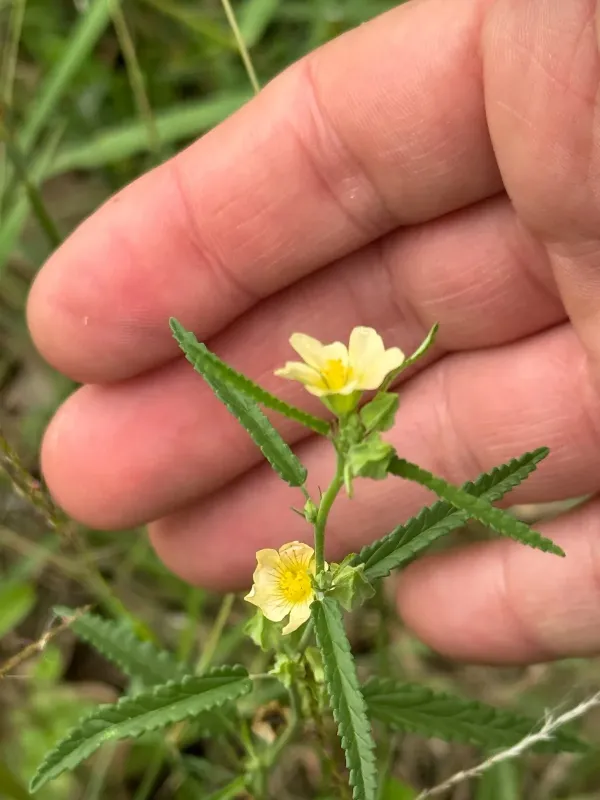
The leaves are alternate, ovate to lanceolate, with serrated margins, while the flowers are small, pale yellow to white, solitary or clustered in leaf axils.
It possesses a strong, deep taproot that allows the plant to survive in various environments and makes manual removal difficult once the plant has matured.
Where it grows
Prickly sida is highly adapted to warm climates and is commonly found in tropical and subtropical regions, particularly across the southern United States.
It thrives in cultivated fields, including cotton, soybean, corn, and sorghum, where it frequently competes with young crops for space and resources.
The plant is also found in non-cropped areas such as roadsides, fence rows, waste areas, and ditches, serving as a source for re-infestation of agricultural land.
It prefers sunny, warm environments with well-drained soils, showing a preference for high light intensity rather than shaded areas under crop canopies.
Seeds are easily dispersed by water runoff, machinery movement, and occasionally through contaminated crop seeds, contributing to its rapid geographical spread.
Harm it causes
Prickly sida acts as a aggressive competitor for nitrogen, water, and sunlight, often causing significant yield losses in crops if left unmanaged during early development.
Its high density can interfere with harvesting operations, leading to equipment clogging and reduced efficiency in mechanized harvesting processes.
The weed serves as a host for various insects and plant diseases, including those that affect cotton crops, thereby increasing the overall pest pressure in the field.
Because of its hard seed coat, the seeds can remain dormant in the soil for several years, creating a persistent seed bank that complicates long-term weed control.
If not controlled early, the plant becomes woody and harder to kill with standard herbicides, requiring more intensive and costly management practices later in the season.
How to control
Effective management begins with cultural practices, such as optimizing crop planting dates to allow the crop to get ahead of the weed emergence.
Mechanical cultivation remains a primary method for controlling prickly sida in row crops, provided it is timed before the weeds develop a deep root system.
Chemical control involves the application of pre-emergence and post-emergence herbicides, ideally timed when the weeds are in the seedling stage (less than 4 leaves).
Integrated weed management should include cleaning field borders and equipment to prevent the movement of seeds from infested areas into clean agricultural fields.
- Application of selective broadleaf herbicides recommended for specific crops.
- Rotating crops to break the cycle of weed infestation.
- Using competitive crop varieties to shade out potential weed growth.
Taxonomy
- Latin name
- Sida spinosa
- Family
- Мальвовые
- EPPO code
- SIDSP