
Sida rhombifolia
Sida rhombifolia
Description
How to tell it apart
Sida rhombifolia, commonly known as arrowleaf sida or Cuban jute, belongs to the Malvaceae family. This plant can grow as a perennial or annual shrub, often reaching a height of up to one meter.
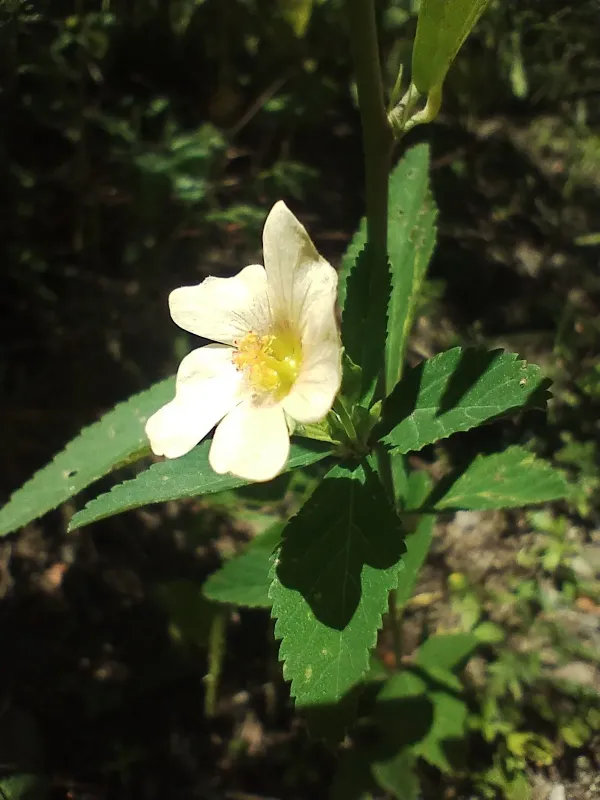
The leaves are rhomboid or lanceolate in shape with characteristic serrated edges on the upper half. The underside of the leaves is often covered with fine hairs, giving it a grayish appearance.
Flowers are typically solitary, emerging from the leaf axils. They have a five-petal structure and are generally pale yellow, white, or pinkish in color.
The plant possesses a robust taproot system, which allows it to penetrate deep into the soil and compete effectively with crop plants for water and essential nutrients.
The fruit is a dry capsule that breaks into individual mericarps. The seeds have small spines that facilitate their dispersal by animals, agricultural machinery, and wind.
Where it grows
This weed is predominantly found in tropical and subtropical regions globally. In temperate zones, it acts as an invasive species, favoring well-lit areas with fertile soil.
Sida rhombifolia actively colonizes roadsides, abandoned pastures, wastelands, and disturbed ground. It adapts quickly to various soil types, including sandy and clay soils.
The plant often becomes a major problem in row crops, such as cotton, corn, soybeans, and peanuts. It is found in both intensive agricultural systems and home gardens.
In high-input farming, the weed prefers moist but well-drained areas where competition from crops is minimal or weakened by poor establishment.
Its ability to propagate rapidly via seeds allows it to quickly occupy new areas, forming dense thickets that displace local flora.
Harm it causes
The primary damage caused by Sida rhombifolia is intense competition for resources. It actively extracts water and minerals, significantly reducing the yield potential of crops.
Dense thickets of this weed shade out crop seedlings, leading to stunted growth, elongation, and reduced photosynthetic activity in the early stages of development.
The stems of the plant are remarkably tough due to high fiber content, which hinders the operation of harvesting machinery, leading to equipment damage and slow harvest speed.
The plant can serve as a reservoir for various agricultural pests and pathogens. Populations of insects often thrive on it before migrating to healthy crop fields.
Furthermore, seeds of arrowleaf sida can contaminate harvested produce, lowering quality standards and requiring additional cleaning processes, which increases production costs.
How to control
Mechanical control methods include high-quality tillage. Deep plowing helps to destroy seedlings and exhaust the seed bank stored in the upper layers of the soil.
Effective crop rotation, utilizing crops that develop a dense canopy quickly, serves as a natural tool to suppress the growth of this persistent weed.
In terms of chemical control, the application of pre-emergence soil herbicides is highly recommended to prevent the germination of Sida rhombifolia seeds.
For post-emergence control, systemic herbicides with hormonal action or amino acid synthesis inhibitors are often used, though resistance to certain compounds must be monitored.
Regular mowing of non-cropped areas, such as field edges and fence lines, prevents flowering and seed production, significantly reducing the weed pressure for the following season.
Taxonomy
- Latin name
- Sida rhombifolia
- Family
- Мальвовые
- EPPO code
- SIDRH