
Sida cordifolia
Sida cordifolia
Description
How to tell it apart
Sida cordifolia, commonly known as heartleaf sida, is a perennial herb or subshrub belonging to the Malvaceae family. It typically grows to a height of one meter.
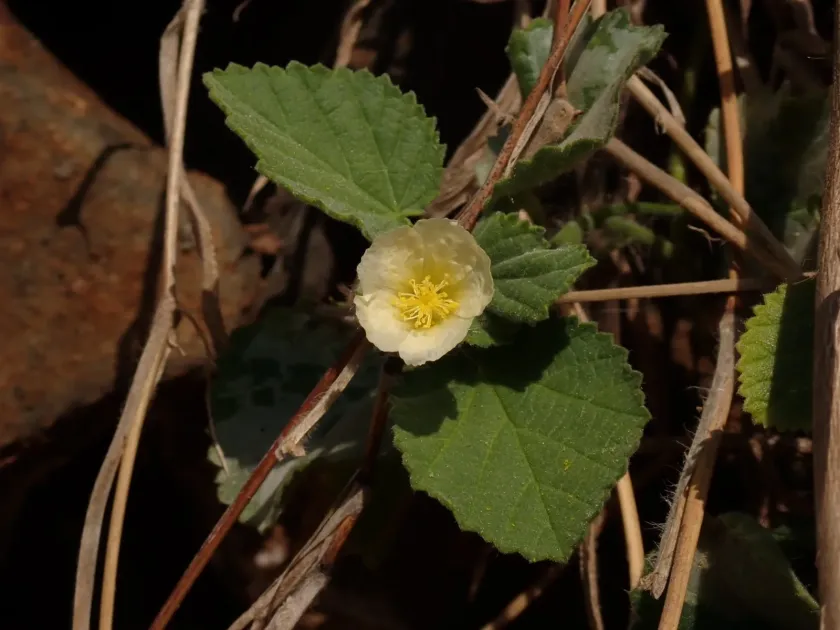
The plant is easily identified by its heart-shaped leaves, which feature serrated margins and a soft, velvety texture due to fine hairs covering the surface.
Flowers are small and pale yellow or orange in color, emerging from the leaf axils. The plant produces distinctive seed pods that break into segments with tiny hooked spines.
The root system consists of a deep taproot, which helps the plant survive in nutrient-poor or dry soil conditions. It is a hardy, opportunistic species.
Botanically, it belongs to the mallow family, showing similar structural traits to other related weeds but possessing unique leaf and seed morphology.
Where it grows
Heartleaf sida is widespread across tropical and subtropical regions worldwide. It thrives in open, disturbed areas such as roadsides, pastures, and fallow fields.
In agricultural settings, it is considered an invasive weed that rapidly colonizes cultivated fields. It prefers well-drained soils but adapts to various types.
It is frequently found interfering with crops such as cotton, sugarcane, and legumes. The plant spreads primarily through seeds dispersed by animals and humans.
Because of its drought tolerance, it remains competitive even in arid climates, often outcompeting native vegetation in degraded landscapes.
Its ability to establish quickly in bare soil makes it a significant issue in fields where crop cover is sparse or poorly maintained.
Harm it causes
The primary harm caused by Sida cordifolia is intense competition with crops for water, sunlight, and essential soil nutrients, leading to yield reductions.
It serves as an alternative host for several crop pests and viruses, increasing the risk of widespread disease outbreaks within agricultural areas.
The presence of this weed in pastures is problematic as its foliage is not favored by livestock, potentially reducing the overall quality of grazing land.
Its tough, fibrous stems can interfere with mechanical harvesting equipment, potentially causing damage or slowing down the efficiency of agricultural machinery.
Contamination of harvested seeds with heartleaf sida seeds lowers the market grade and quality of the final crop output.
How to control
Effective control requires an integrated approach, starting with mechanical management. Deep plowing helps disrupt the root system and bury seeds to prevent germination.
Cultural practices are essential to long-term control. Maintaining vigorous crop stands helps shade out the weed and limit its spread during the growing season.
- Mowing before seed set is critical to prevent the population from expanding.
- Crop rotation with smother crops reduces weed emergence.
- Regular field monitoring to spot-treat early infestations.
Chemical control involves applying systemic herbicides during the plant's active growth phase to ensure the chemical reaches the root system.
Post-emergence applications of selective herbicides are effective in fields, provided they are applied before the plant matures and becomes woody.
Taxonomy
- Latin name
- Sida cordifolia
- Family
- Мальвовые
- EPPO code
- SIDCO