
Coromandel mallow
Malvastrum coromandelianum
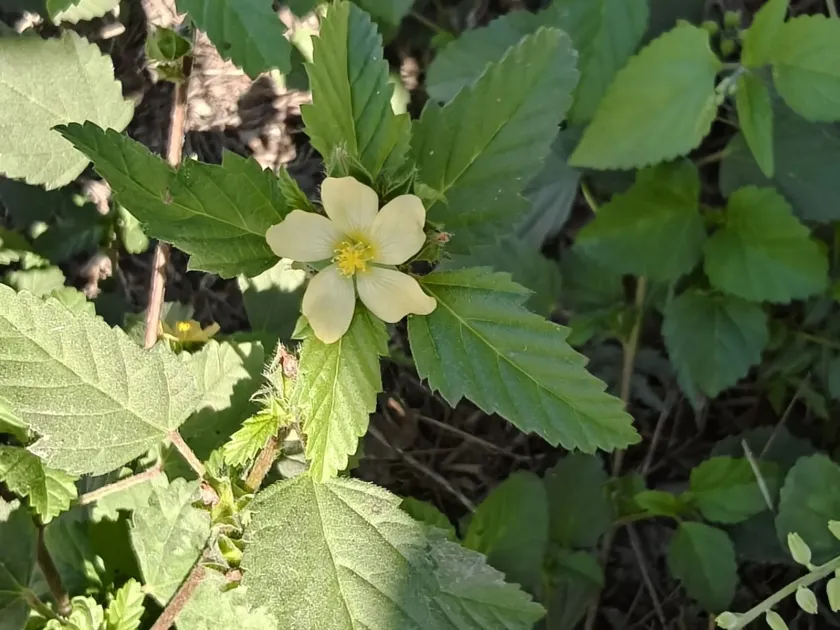
Description
How to tell it apart
Coromandel mallow (Malvastrum coromandelianum) is a member of the Malvaceae family. It is an annual or short-lived perennial herb that often takes on a semi-shrubby growth habit.
The stems are erect or ascending and branched, reaching heights of 30 to 100 cm. The surface of the stems is characteristically covered with appressed, star-shaped hairs.
The leaves are alternate, petiolate, and have stipules. They are lanceolate to ovate in shape, with serrated margins, which is a key identifying morphological feature.
The flowers are solitary and situated in the leaf axils, featuring bright yellow to orange-yellow petals. The fruit is a schizocarp that breaks into several segments, each containing a single seed.
It possesses a strong taproot system, which allows the plant to thrive in dry conditions and persist in nutrient-poor or disturbed soils, making it a resilient colonizer.
Where it grows
This weed is native to tropical and subtropical regions and is widely distributed as an invasive species in many parts of the world. It thrives in disturbed habitats, roadsides, and waste areas.
In agriculture, it is a significant weed in row crops such as cotton, soybeans, corn, and sugarcane, where it can quickly establish dense populations if left unmanaged.
The plant prefers sunny locations with well-drained soil. It is highly opportunistic and often invades fields following primary tillage if the crop fails to establish quickly enough to provide ground cover.
Dispersal is primarily facilitated by agricultural machinery, contaminated seed lots, and movement of soil, which allows it to spread rapidly across farm boundaries.
Because of its ecological plasticity, it can also be found in overgrazed pastures and along irrigation ditches, where it can outcompete native vegetation.
Harm it causes
The primary damage caused by Coromandel mallow is competition with crops for water, light, and soil nutrients, which leads to significant reductions in overall crop yield.
It acts as a reservoir host for various viral and fungal diseases that affect major economic crops, thereby increasing the risk of widespread infections within a farm operation.
The presence of dense mallow patches during harvest time interferes with mechanical operations, potentially causing damage to equipment or reducing the efficiency of harvesting.
Contamination of harvested grain with mallow seeds can lower the quality of the final product, necessitating costly cleaning procedures and decreasing market value.
On livestock ranges, it is often avoided by cattle due to its rough texture, leading to decreased grazing capacity and shifts in plant community composition toward less palatable species.
How to control
Managing Coromandel mallow requires an integrated strategy that focuses on prevention, early detection, and the use of both mechanical and chemical control tactics.
Mechanical control, such as timely inter-row cultivation, is highly effective if carried out while the weeds are in the seedling stage, before they develop deep roots or set seed.
Cultural practices, including the use of competitive crop varieties and proper plant spacing, are essential for shading out the weed and limiting its ability to establish in the field.
Chemical control involving systemic herbicides should be targeted for the early growth stages of the weed, ensuring compliance with local crop protection regulations for specific crops.
- Implement rigorous field border maintenance to prevent weed encroachment.
- Use certified weed-free seed for planting to avoid introducing new infestations.
- Clean all equipment thoroughly when moving between fields to prevent seed dispersal.
Taxonomy
- Latin name
- Malvastrum coromandelianum
- Family
- Мальвовые
- EPPO code
- MAVCO