
Crested Anoda
Anoda cristata
Description
How to tell it apart
Crested Anoda (Anoda cristata) is an annual broadleaf weed belonging to the Malvaceae family, sharing many common characteristics with mallows.
The plant grows upright and branched, typically reaching heights of 30 to 90 centimeters, with stems covered in soft, sometimes stiff hairs.
Its leaves are variable in shape, often arrow-shaped or triangular, with dentate margins, and are arranged alternately along the stem.
The flowers are distinct and showy, featuring petals that range in color from pale pink or blue to purple, blooming solitary in leaf axils.
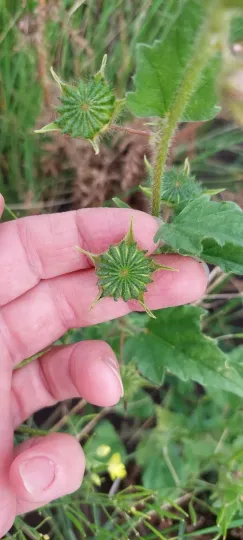
The fruit is a disk-shaped capsule that splits into several segments at maturity, each containing small, dark-colored seeds capable of rapid germination.
Where it grows
Native to tropical America, Crested Anoda has spread extensively to various parts of the world, becoming a troublesome weed in agricultural ecosystems.
It thrives in fertile, well-watered soils and is most commonly found in row crops, including corn, soybeans, cotton, and various vegetable gardens.
The weed also occupies disturbed sites such as roadsides, irrigation ditches, and fallow fields, which serve as reservoirs for its continuous spread.
Crested Anoda is highly adaptable, allowing it to flourish under diverse environmental conditions, including moderate drought, provided the soil moisture is sufficient for early growth.
Seeds are frequently dispersed by water movement, farm machinery, and contaminated crop seeds, contributing to the infestation of previously clean fields.
Harm it causes
The primary damage caused by Crested Anoda is its aggressive competition with crops for essential resources, including nitrogen, phosphorus, water, and sunlight.
Because it establishes quickly, it can easily overtop young crop seedlings, significantly reducing their ability to photosynthesize and slowing overall development.
This weed acts as a host for various insects and plant pathogens, increasing the risk of pest and disease outbreaks that can further harm the main crop.
Heavy infestations of the weed can physically interfere with harvesting equipment, leading to increased wear and tear and decreased efficiency during harvest time.
The plant's high seed production rate ensures it maintains a robust seed bank in the soil, which necessitates intensive management over multiple growing seasons.
How to control
Effective management of Crested Anoda requires an integrated approach that combines cultural practices with the judicious use of chemical herbicides.
Cultural control involves mechanical cultivation, such as tillage and inter-row hoeing, which is most effective when the weeds are in the seedling stage.
Crop rotation remains a fundamental strategy, alternating competitive crops with others to disrupt the lifecycle of the weed and minimize its buildup in the soil.
Chemical control focuses on applying selective herbicides that are effective against Malvaceae species, applied at the optimal growth stage of the weed.
- Regular monitoring of fields to detect early infestations before seed set.
- Using pre-emergence herbicides to prevent germination of the soil-stored seed bank.
- Sanitizing farm machinery to prevent the movement of seeds between infested and non-infested areas.
Taxonomy
- Latin name
- Anoda cristata
- Family
- Мальвовые
- EPPO code
- ANVCR