
Polypremum procumbens
Polypremum procumbens
Description
How to tell it apart
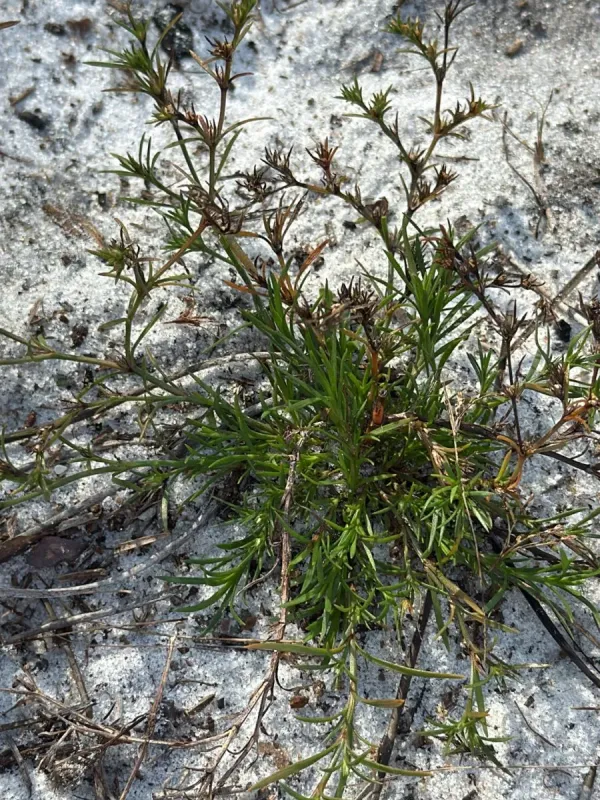
Polypremum procumbens, commonly known as rustweed, is a small, herbaceous plant belonging to the Loganiaceae family. It is characterized by its prostrate or spreading growth habit, often forming dense, low-growing mats.
The stems of the plant are highly branched and carry small, linear-lanceolate, opposite leaves. A distinctive feature is the presence of stipules that fuse into a small, membranous sheath at the leaf base.
The flowers of Polypremum procumbens are tiny, white to greenish-white, and situated in the leaf axils. The calyx is deeply divided into four pointed segments, giving the flower a star-like appearance.
Its root system is fibrous and relatively shallow, which enables the plant to thrive in dry, sandy, or disturbed soil conditions where larger competitors might struggle.
The plant reproduces through prolific seed production, with seeds housed in small capsules. Its ability to produce vast quantities of seeds allows it to colonize agricultural land rapidly.
Where it grows
This species is native to warmer regions, particularly across the Americas, where it thrives in subtropical and tropical climates. It is well-adapted to environments with high light intensity.
Common habitats include sandy soils, dry or moist banks, roadsides, and fallow agricultural fields. It is frequently found in disturbed soils where native vegetation has been removed.
In agricultural settings, it frequently infests row crops, vegetable gardens, and nurseries, often going unnoticed due to its small stature and low profile.
The plant is highly resilient to nutrient-poor soils, allowing it to become a significant competitor in fields that lack high fertility, where crop growth is inherently slower.
Dispersal occurs primarily via seed movement facilitated by wind, water runoff, and human activity, particularly through contaminated farm machinery used across multiple fields.
Harm it causes
The primary harm caused by Polypremum procumbens is its intense competition with young crops for essential moisture and soil nutrients during the critical stages of early development.
Even though it does not grow tall enough to shade out most crops, its mat-forming nature depletes the surface soil layer, restricting the healthy development of root systems in cultivated plants.
Infestations complicate standard field maintenance, as the prostrate growth of the weed makes it difficult to eliminate using conventional mechanical cultivation techniques.
Polypremum procumbens can serve as an alternative host for various plant pathogens and pests, which can then migrate to high-value crops, jeopardizing field sanitation.
Ultimately, heavy competition from this weed leads to significant reductions in both yield quantity and the overall quality of agricultural output.
How to control
Managing rustweed requires an integrated approach that focuses on both physical soil disturbance and strategic chemical interventions to reduce the seed bank.
Effective primary tillage, such as deep plowing, can bury seeds at depths that inhibit successful germination, thereby reducing initial weed pressure in the seedbed.
Pre-emergence herbicides are highly recommended to establish a soil barrier that prevents the weed from germinating during the initial stages of crop development.
Implementing effective crop rotation is essential, specifically selecting crops that provide dense canopy cover to naturally shade out this light-dependent weed species.
- Monitor field edges and drainage areas for early detection.
- Sanitize agricultural equipment to prevent seed transport.
- Apply selective herbicides during the early growth phase of the crop.
Taxonomy
- Latin name
- Polypremum procumbens
- Family
- Логаниевые
- EPPO code
- POEPR