
Bluecurls
Trichostema lanceolatum
Description
How to tell it apart
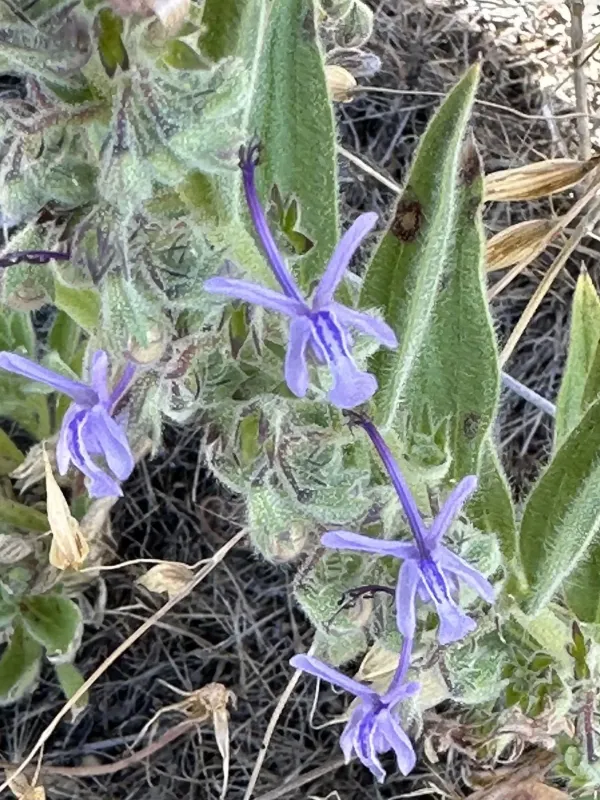
Bluecurls, scientifically known as Trichostema lanceolatum, is an annual herbaceous plant belonging to the Lamiaceae (mint) family. It is easily recognized by its strong, pungent odor released when the leaves are crushed.
The plant typically grows between 10 to 60 centimeters in height, featuring an upright stem that is often branched near the base. The leaves are opposite and exhibit a characteristic lanceolate shape, providing the basis for its specific epithet.
The flowers of the bluecurls are distinct due to their long, curved stamens that extend significantly beyond the corolla. These flowers are usually blue, violet, or lavender and grow in terminal inflorescences.
The seeds are highly persistent in the soil, allowing the plant to remain viable in the soil seed bank for extended periods. The entire life cycle is completed within a single growing season.
Most parts of the plant are covered with glandular hairs, which give the plant a sticky texture to the touch, a feature that serves as a useful diagnostic trait for field identification.
Where it grows
Bluecurls is native to western North America, particularly abundant in California and Oregon. The plant thrives in open, sunny areas with well-drained, sandy, or disturbed soil types.
In agricultural settings, it is commonly found in pastures, fallow fields, and grain crops. It frequently colonizes disturbed ground where there is minimal competition from perennial vegetation.
The species often populates roadsides and dry hillsides, from which its seeds are easily transported by agricultural machinery onto arable land. Its ability to tolerate hot, dry climates makes it a resilient competitor.
The plant demonstrates a preference for lighter soils where other crops might struggle, allowing it to quickly establish dense populations if the soil remains undisturbed during its germination phase.
After primary soil preparation, bluecurls can emerge rapidly, quickly occupying the available space in fields and becoming a challenge for crop establishment.
Harm it causes
The primary harm caused by bluecurls is its intense competition with crops for water and soil nutrients, especially during the dry periods of the growing season. Its robust root system allows it to access resources efficiently.
In cases of heavy infestation, the weed significantly reduces crop yields by shading out younger seedlings and inhibiting their overall growth, leading to sparse and less productive crop stands.
The sticky nature of the plant and its dense growth habit make it a nuisance during harvest, as it can clog the intake and threshing mechanisms of harvesting machinery, increasing downtime and maintenance costs.
In pasture environments, bluecurls can be problematic because its strong odor and essential oils make it unpalatable to livestock, which effectively reduces the grazing capacity of the land.
Furthermore, the plant can act as an alternative host for various insect pests and pathogens, providing a refuge from which these threats can migrate to cultivated crops.
How to control
Effective management of bluecurls requires an integrated approach that utilizes both mechanical and chemical control strategies. Early intervention is key to preventing seed bank buildup.
Mechanical control measures, such as deep tillage, can help bury the seeds to a depth that prevents successful germination. Crop rotation with competitive cover crops is also highly recommended.
Chemical control usually involves the application of selective systemic herbicides during the early vegetative growth phase of the weed. Product selection must be tailored to the specific crop being protected.
- Implement timely mechanical cultivation in crop rows before flowering.
- Use weed-free, certified crop seeds to prevent the introduction of new populations.
- Apply pre-emergence or post-emergence herbicides appropriate for the specific cropping system.
- Mow roadsides and field edges before the plants reach the seed-set stage.
- Maintain optimal soil fertility to enhance the crop's ability to outcompete weeds.
Consistent field scouting is essential to catch outbreaks before they reach the stage of seed dispersal, as the long-term viability of seeds in the soil necessitates multi-year monitoring.
Taxonomy
- Latin name
- Trichostema lanceolatum
- Family
- Яснотка пурпурная
- EPPO code
- TRMLA