
Teucrium integrifolium
Teucrium integrifolium
Description
How to tell it apart
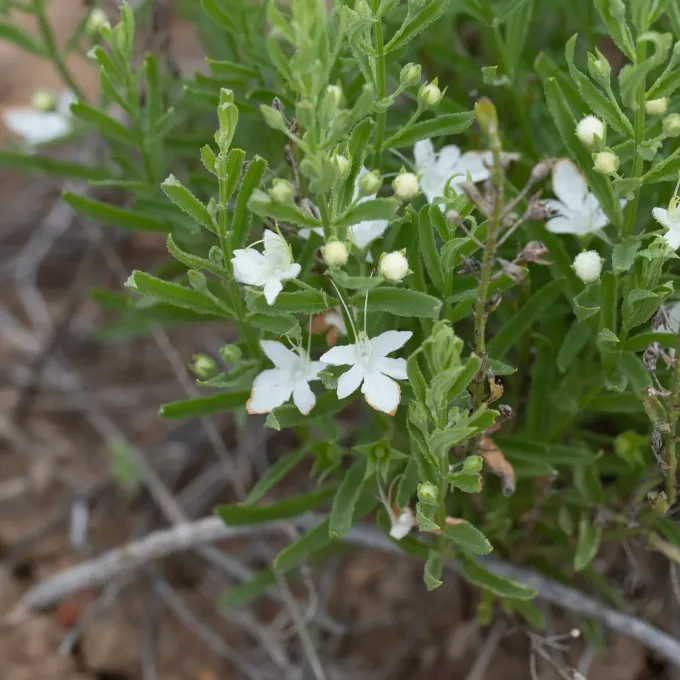
Teucrium integrifolium is a perennial herbaceous plant belonging to the Lamiaceae family. It is characterized by its entire leaves and upright, often branched stems with fine pubescence.
The root system is well-developed, allowing the plant to persist in the soil and regenerate effectively even after mechanical disturbance of the aerial parts.
The flowers are arranged in terminal spikes or heads with a distinct two-lipped corolla, usually displaying pinkish or purplish shades typical for the genus.
Biologically, it acts as a drought-tolerant species capable of thriving in varied ecological conditions, which makes it a persistent weed in managed agricultural landscapes.
Reproduction occurs via both seeds and vegetative expansion, facilitating the spread of the plant within cultivated fields and along field margins.
Where it grows
This weed thrives in open, sunny environments such as dry meadows, steppes, and rocky slopes, frequently invading agricultural fields from these natural habitats.
In cultivated fields, it is particularly problematic in row crops where insufficient inter-row cultivation allows it to establish extensive root networks.
Teucrium integrifolium is highly adaptable to poor or saline soils, enabling it to colonize neglected fallow lands or areas with low soil fertility faster than most crops.
Seeds are dispersed by wind and water, meaning fields adjacent to wild, unmanaged landscapes are at constant risk of colonization during the growing season.
The plant's resilience to extreme temperature fluctuations allows it to dominate in arid regions where moisture stress weakens competing agricultural crops.
Harm it causes
The primary economic damage caused by this weed is its intense competition for water and soil nutrients, directly reducing the available resources for crop production.
By competing within the rhizosphere, it suppresses the growth of young crops, often leading to patchy stands and significantly lower overall yields at harvest time.
The presence of dense weed patches during harvest interferes with machinery performance, potentially clogging equipment and increasing operational downtime.
In forage crops, Teucrium integrifolium lowers the nutritional value of harvested hay and may contaminate feed with non-palatable biomass.
Additionally, the weed acts as an alternative host for various agricultural pests and pathogens, maintaining infection cycles between cropping seasons.
How to control
Effective management requires a combination of deep primary tillage to invert the soil and physical exposure of the weed's roots to desiccation.
Implementing a robust crop rotation strategy is essential to disrupt the weed's life cycle and provide competitive cover that limits its development.
Chemical control is most effective when using systemic herbicides applied during the plant's active vegetative growth phase to ensure translocation to the roots.
Maintaining clean field borders and managing non-cropped areas prevents the influx of seeds, reducing the overall pressure in the following seasons.
- Deep soil plowing.
- Regular inter-row mechanical cultivation.
- Systemic herbicide application.
- Managing field borders and margins.
Taxonomy
- Latin name
- Teucrium integrifolium
- Family
- Яснотка пурпурная
- EPPO code
- TEUIN