
Northern bugleweed
Lycopus uniflorus
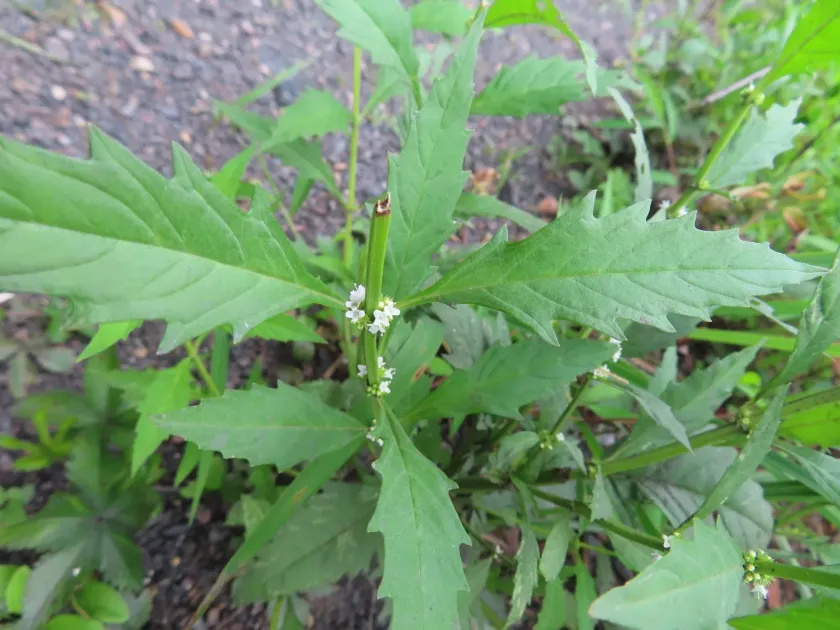
Description
How to tell it apart
Northern bugleweed (Lycopus uniflorus) is a perennial herbaceous plant belonging to the mint family (Lamiaceae). It is characterized by the production of slender stolons that terminate in small tuberous swellings.
The stem is erect and quadrangular, typically growing 10 to 50 centimeters in height. Its leaves are opposite, oblong-lanceolate, and feature serrated margins, which is a key diagnostic feature for the genus.
The flowers are small, arranged in dense axillary whorls. The corolla is white with distinct purple dots inside. A critical identification feature is that the calyx lobes are generally shorter than the corolla, distinguishing it from other bugleweed species.
As a hygrophyte, this plant is naturally adapted to moist, saturated environments. Its root system is capable of vigorous vegetative propagation, which makes it a persistent weed in suitable habitats.
The plant reproduces through both seeds and rhizome fragments. Mechanical soil disturbance, especially when the soil is wet, encourages the spread of these rhizomes across agricultural fields.
Where it grows
Northern bugleweed is typically found in wetland meadows, along the edges of ponds, ditches, and in poorly drained sections of arable land. It thrives in areas with high water tables.
In agricultural settings, it is most troublesome in fields located on reclaimed peatlands or heavy clay soils where moisture retention is high and drainage is often insufficient.
It frequently occurs in crops planted near riparian zones or drainage systems where hydrological conditions remain unstable throughout the growing season.
Because it tolerates temporary flooding better than many crops, Northern bugleweed can quickly dominate low-lying areas of a field that would otherwise be difficult for common weeds to colonize.
Dissemination often occurs through water flow, as well as via farm equipment that transports soil containing stolon fragments from one part of the field to another.
Harm it causes
The primary damage caused by Northern bugleweed stems from its ability to form dense colonies that compete with crops for light, nutrients, and space, significantly reducing overall yields.
By absorbing significant amounts of water and nutrients, it creates competitive stress for crops, particularly in areas where soil aeration is already limited due to excessive moisture.
The presence of this weed complicates mechanical operations; saturated soils infested with bugleweed can hinder the movement of heavy machinery, leading to delayed planting or harvesting schedules.
Contamination of harvested products with plant biomass increases moisture content, which can degrade the quality of grain or vegetables and lead to spoilage during storage.
Furthermore, this weed can serve as an alternate host for various pests and pathogens that may subsequently spread to desirable crop species, necessitating additional chemical interventions.
How to control
The most effective long-term strategy for managing Northern bugleweed is the improvement of field drainage. By addressing the hydrological issues and reducing soil moisture, the habitat becomes unsuitable for the plant.
Cultural control measures, such as deep plowing with a moldboard plow, can help bury and deplete the energy reserves of the stolons, reducing the weed's regenerative capacity.
Implementing a crop rotation that includes vigorous, fast-growing crops can provide enough canopy shade to naturally suppress bugleweed growth during the early stages of development.
Chemical control with systemic herbicides can be effective if applied during the weed's active growth phase, provided that environmental conditions allow for optimal chemical uptake.
- Regular monitoring of low-lying and wet field sections.
- Maintenance of drainage ditches to prevent water logging.
- Application of labeled herbicides during periods of active weed growth.
- Sanitation of equipment to prevent the spread of stolon fragments.
Taxonomy
- Latin name
- Lycopus uniflorus
- Family
- Яснотка пурпурная
- EPPO code
- LYAUN