
Gypsywort
Lycopus europaeus
Description
How to tell it apart
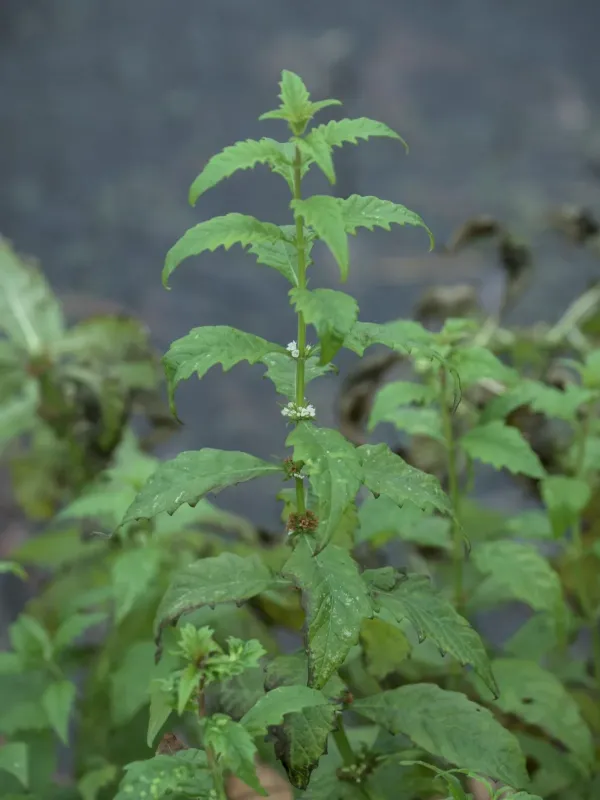
Gypsywort (Lycopus europaeus) is a perennial herbaceous plant belonging to the Lamiaceae family. It typically grows with a square-shaped stem that can reach up to 100 cm in height.
The leaves are opposite, lanceolate in shape, with serrated edges, and are sometimes deeply lobed at the base. It reproduces via a creeping rhizome system that allows for rapid expansion.
The flowers are small, appearing in dense clusters in the leaf axils, and are white or pale pink with small purple spots. Unlike some of its relatives, the plant lacks a strong aromatic scent.
As a hydrophyte, the species thrives in environments where water is abundant. It spreads both through seed dispersal and vegetative propagation from root fragments.
The growth cycle usually begins in early spring, with the flowering phase occurring from June through September, depending on the local climate and soil moisture levels.
Where it grows
Gypsywort is primarily found in damp habitats, including riverbanks, ditches, marshes, and areas with poor drainage or high water tables.
In agricultural settings, it is a persistent weed in low-lying fields, reclaimed peatlands, and areas that suffer from seasonal waterlogging after heavy rains.
It often infiltrates crop rows from surrounding uncultivated areas, such as irrigation canals or neglected buffer zones between fields.
The plant is highly adaptable to moist soil conditions, making it difficult to eradicate once it establishes a foothold in poorly drained agricultural land.
Its presence is often a clear indicator of a need for better soil management and improved drainage infrastructure within the farm.
Harm it causes
The primary damage caused by Gypsywort is its intense competition with crops for water and mineral nutrients, especially in wet field conditions.
By forming dense, localized thickets, it shades out smaller or slow-growing crop plants, significantly reducing the potential yield per hectare.
The rhizomes can interfere with the physical structure of the soil and compete for space, inhibiting the development of the root systems of main crops.
During harvest, the robust stems can clog mechanical equipment, leading to inefficiencies and requiring more frequent maintenance and downtime.
Additionally, the weed can act as an alternative host for various pests and diseases that can eventually spread to commercial vegetable or grain plantings.
How to control
The most effective long-term strategy for controlling Gypsywort is improving soil drainage to eliminate the wet conditions it requires for optimal growth.
Mechanical control through deep plowing and cultivation is essential to expose and desiccate the rhizomes, preventing them from resprouting.
- Regular cultivation of fallow fields to deplete root reserves.
- Systematic maintenance and cleaning of adjacent irrigation and drainage ditches.
- Targeted application of herbicides on highly infested spots after crop harvest.
Chemical control involving systemic herbicides applied to the foliage is effective at translocating toxins down to the root system, killing the plant entirely.
Integrating these methods into a comprehensive weed management program is crucial for maintaining field health and maximizing agricultural output.
Taxonomy
- Latin name
- Lycopus europaeus
- Family
- Яснотка пурпурная
- EPPO code
- LYAEU