
Rough bugleweed
Lycopus asper
Description
How to tell it apart
Rough bugleweed (Lycopus asper) is a perennial herbaceous plant belonging to the Lamiaceae family, classified as a rhizomatous weed.
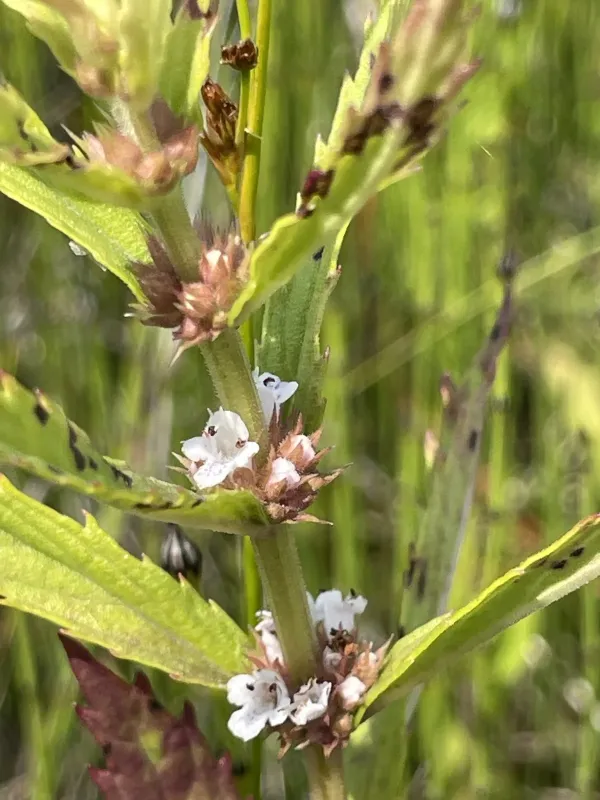
The plant features a square, upright stem that can reach heights of 30 to 80 centimeters, often with a rough texture and occasional branching near the top.
The leaves are lanceolate or oblong with serrated edges, arranged oppositely along the stem, giving the plant its distinct appearance.
Flowers are small and arranged in dense whorls in the leaf axils, typically featuring white to pale pink petals with purple spots.
It propagates primarily through an extensive system of creeping rhizomes, which allow the plant to spread rapidly and survive in various soil conditions.
Where it grows
Rough bugleweed is typically found in moist to wet habitats, such as riverbanks, lake shores, marshes, and low-lying, poorly drained agricultural areas.
In farming, it is considered a problematic weed in reclaimed wetlands and fields where high moisture levels and poor drainage occur.
It frequently infests fields planted with small grains or row crops when water management is insufficient, leading to waterlogged soil conditions.
The plant demonstrates significant ecological plasticity, allowing it to colonize diverse landscapes ranging from organic-rich soils to heavy clays.
It often thrives along irrigation ditches and in areas where persistent moisture keeps the soil profile saturated throughout the growing season.
Harm it causes
The main agricultural damage caused by rough bugleweed is intense competition with crops for limited soil moisture and essential mineral nutrients.
Its vigorous rhizome network can form dense colonies that suppress the growth of neighboring crops by occupying the root zone space.
Dense infestations of this weed create heavy ground cover, which shades out young crop seedlings and disrupts their natural photosynthetic development.
During the harvest period, high densities of bugleweed can interfere with agricultural machinery, leading to increased grain impurities and loss of yield quality.
Rough bugleweed can also act as an alternate host for various pathogens and pests, potentially increasing the disease pressure within the field.
How to control
The primary control measure for rough bugleweed is improving field drainage to mitigate the moisture levels that favor the plant's colonization.
Mechanical control, including deep plowing and regular discing, is essential to expose and desiccate the rhizomes, effectively reducing their vigor.
Strategic crop rotation, especially using competitive cover crops, can significantly hinder the weed's ability to establish and spread.
Post-harvest application of systemic, non-selective herbicides, such as glyphosate, is highly effective for managing established rhizomatous patches.
- Frequent shallow tillage to exhaust the nutrient reserves in the rhizome system over the season.
- Application of selective herbicides during the crop's active growth stage according to local guidelines.
- Maintaining well-structured, drained soil to prevent the onset of favorable growing conditions for the weed.
Taxonomy
- Latin name
- Lycopus asper
- Family
- Яснотка пурпурная
- EPPO code
- LYAAS