
American water horehound
Lycopus americanus
Description
How to tell it apart
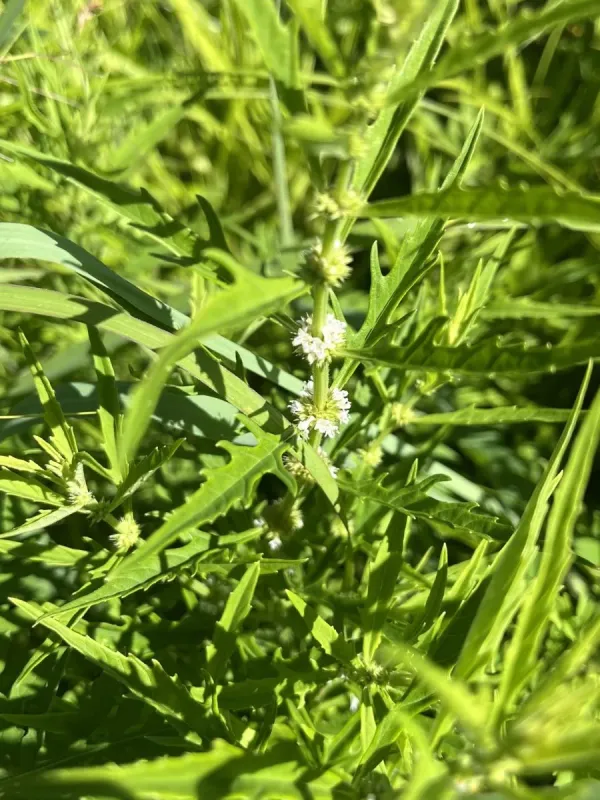
American water horehound is a perennial herb belonging to the Lamiaceae family, characterized by a square stem that can reach up to 90 cm in height.
The leaves are opposite, lanceolate, and deeply toothed or pinnately lobed, which serves as a primary diagnostic feature for identifying this specific species.
Flowers are arranged in dense axillary clusters at the upper nodes of the stem, often displaying a white corolla with tiny, faint purple spots.
The root system consists of creeping rhizomes that allow the plant to spread vegetatively, often forming dense colonies in suitable environments.
It is important to differentiate this species from other Lycopus members by observing the leaf morphology and the density of the flower clusters at the nodes.
Where it grows
This weed thrives in moist to wet habitats, commonly found along streambanks, marshes, ditches, and in poorly drained agricultural depressions.
In agricultural fields, it typically colonizes low-lying areas where water persists, making it a persistent issue in fields with inadequate drainage.
The plant often spreads into fields via contaminated irrigation water or machinery that transports rhizome segments from infested water bodies.
It acts as an indicator species for soil moisture issues; its presence is a clear signal that the field requires better land leveling or subsurface tiling.
The species is particularly problematic in row crops where the microclimate provides the consistent soil moisture needed for its rapid expansion.
Harm it causes
The main impact of American water horehound is the reduction of crop yield due to intense competition for water and soil nutrients in wet field zones.
Its vigorous growth shades out smaller crop seedlings, hindering their development during the critical early growth stages of the season.
The dense vegetative cover created by the weed provides a reservoir for pests and pathogens that can eventually spread to surrounding crop plants.
Harvesting efficiency is often compromised as the biomass of the weed interferes with combine harvester components, increasing downtime and fuel consumption.
Failure to control the weed population can lead to severe crop suppression, effectively turning productive field patches into non-productive areas.
How to control
Long-term control relies heavily on improving soil drainage and land management practices to eliminate the persistent moisture that favors this weed.
Frequent mechanical cultivation during the growing season can effectively deplete the energy reserves stored within the rhizomes of the plant.
Chemical control should focus on the application of systemic herbicides during periods of active plant growth to ensure translocation to the root system.
- Applying glyphosate-based herbicides on fallow ground to kill rhizomes.
- Using selective post-emergence herbicides registered for the specific crop.
- Ensuring that field machinery is cleaned to prevent the spread of rhizomes.
- Implementing tile drainage systems to manage excess water levels in fields.
Combining mechanical strategies with precise herbicide application provides the most sustainable approach to keeping American water horehound under control.
Taxonomy
- Latin name
- Lycopus americanus
- Family
- Яснотка пурпурная
- EPPO code
- LYAAM