
Hyptis capitata
Hyptis capitata
Description
How to tell it apart
Hyptis capitata belongs to the Lamiaceae family. It is a perennial herbaceous plant that often takes on a semi-shrubby growth habit.
The stems are erect, branched, and can reach heights of up to 1.5–2 meters, giving the plant a prominent presence in the field.
The leaves are arranged oppositely and have a lanceolate shape with serrated margins, which is a key identifying characteristic of the vegetative stage.
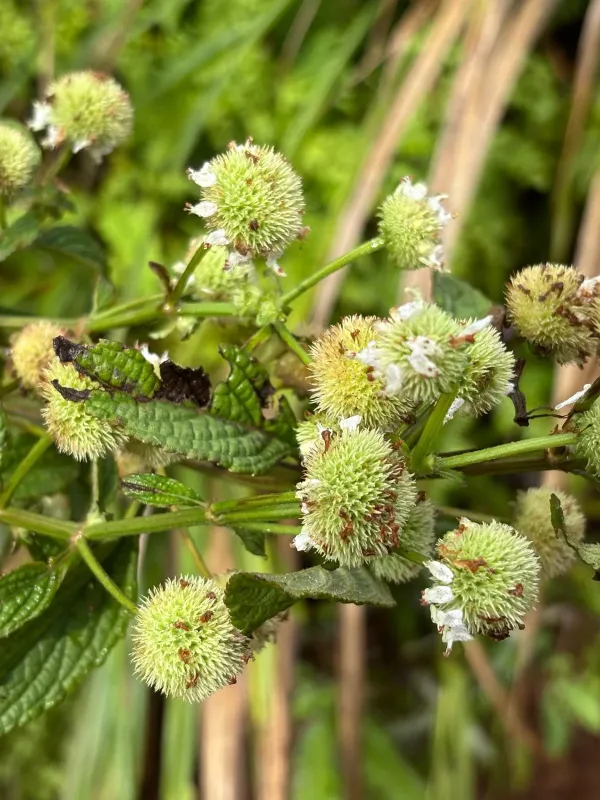
The plant is most recognizable by its distinctive inflorescences, which appear as dense, spherical heads formed in the leaf axils on long peduncles.
It possesses a strong and deep root system, providing it with high resilience and the ability to thrive across various soil types.
Where it grows
This species is a tropical weed widely distributed in Asia, Oceania, and Australia, often invading pastures and agricultural landscapes.
It typically occupies disturbed areas, such as roadsides, abandoned fields, and edges of plantations, where it can rapidly establish large colonies.
In agriculture, it frequently causes significant losses in plantations of sugarcane, rubber, and various tropical orchard crops.
The plant thrives in moist, well-lit environments but shows high adaptability to a wide range of ecological conditions, making it a persistent invader.
Its ability to colonize secondary forests and agricultural lands highlights its status as a serious environmental and agricultural threat.
Harm it causes
The main harm caused by Hyptis capitata is its aggressive competition for sunlight, water, and nutrients, which significantly suppresses crop growth.
Dense thickets of this weed create physical barriers, making it difficult to perform mechanized field operations or harvest crops efficiently.
The plant depletes soil fertility and forms large monoculture patches that can take years to clear, causing long-term damage to field productivity.
Hyptis capitata can act as an alternative host for various agricultural pests and diseases, increasing the overall pressure on crops.
In grazing areas, it displaces palatable forage species, reducing the overall carrying capacity and quality of pastures for livestock.
How to control
A successful control program involves regular mowing before flowering to exhaust the root reserves and prevent the spread of seeds.
Deep tillage is effective for destroying existing infestations, although it must be repeated systematically to ensure complete control of the rootstock.
Chemical control usually requires the application of systemic herbicides, particularly glyphosate-based products, during the plant's active growth phase.
Preventative measures, such as monitoring for early outbreaks and cleaning farm equipment, are essential to stop the weed from spreading to clean fields.
- Manual removal of young plants before seeding.
- Systemic herbicide application in infested areas.
- Cover cropping to shade out and suppress weed growth.
- Regular field scouting and prompt isolation of colonies.
Taxonomy
- Latin name
- Hyptis capitata
- Family
- Яснотка пурпурная
- EPPO code
- HPYCA