
Hyptis brevipes
Hyptis brevipes
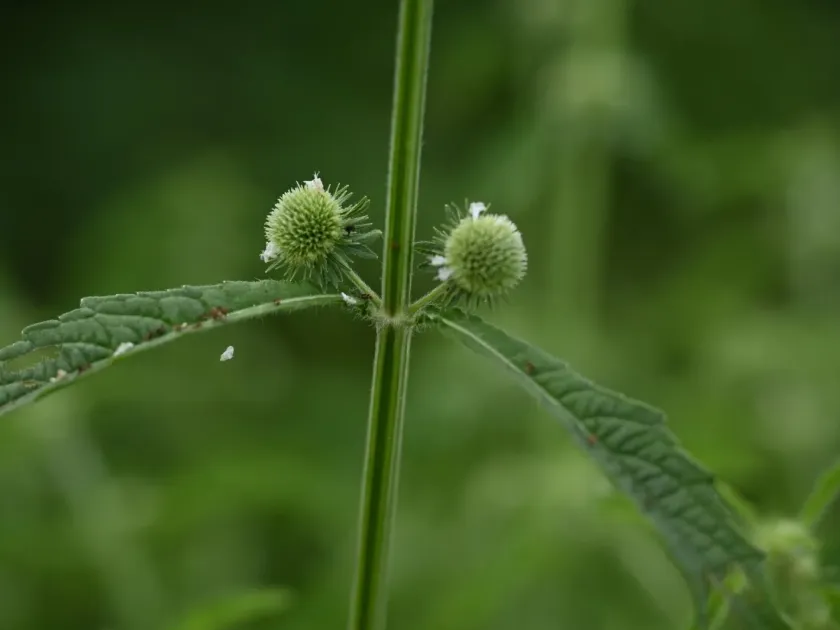
Description
How to tell it apart
Hyptis brevipes is an annual herbaceous plant belonging to the Lamiaceae family. It typically grows as an erect or ascending plant, reaching heights of one meter or more under favorable environmental conditions in tropical regions.
The leaves are arranged oppositely along the stem and are generally lanceolate or ovate in shape, featuring serrated margins. The leaf surface is often pubescent, which is a common characteristic among many species in the mint family.
The inflorescences are dense, spherical heads formed in the leaf axils. The flowers are small, ranging in color from white to pale purple, and are protected by rigid calyces that persist as the fruit matures.
Biological propagation is primarily through the production of numerous seeds. These seeds are known for their longevity in the soil, allowing the plant to persist through various seasons and quickly emerge when conditions are optimal.
The root system is fibrous and quite vigorous, enabling the plant to compete effectively for water and soil nutrients. This adaptability makes it a challenging weed in both cultivated fields and disturbed environments.
Where it grows
Hyptis brevipes is widely distributed across tropical and subtropical regions of the world, including parts of Asia, Africa, and the Americas. It thrives in warm, humid climates and is frequently found in areas with high rainfall.
It is a common weed in agricultural settings, particularly in rice paddies, maize fields, and soybean plantations. Furthermore, it colonizes roadsides, drainage ditches, and moist wastelands, often serving as a source for further field infestation.
The plant prefers loose, fertile, and moist soils. It is highly aggressive in colonizing cleared land, rapidly forming dense patches that can dominate the local vegetation and suppress less competitive plant species.
Dispersal occurs via wind, water, and human activity, particularly through contaminated farm machinery and agricultural equipment. Its mobility allows it to spread across large distances, invading new agricultural areas rapidly.
Its plasticity in responding to environmental changes ensures its survival in various land-use patterns, making it a persistent problem for farmers who rely on traditional cultivation methods.
Harm it causes
The primary harm caused by Hyptis brevipes is its intense competition with crops for sunlight, water, and nutrients. Rapid vegetative growth allows it to overtop young crop plants, severely limiting their photosynthetic efficiency.
In addition to resource competition, the presence of the weed in crop fields leads to significant yield losses. It disrupts the development of crops, reducing the overall biomass and harvest quality of staple food products.
Hyptis brevipes acts as a reservoir for various agricultural pests and pathogens. These can easily spread to primary crops, necessitating increased expenditure on pesticides and potentially compromising the health of the entire field.
Contamination of the harvested product with the seeds of this weed decreases its commercial value. This often requires additional post-harvest processing, such as cleaning and sorting, which increases labor and operational costs.
Dense stands of the plant can also interfere with mechanized farming operations, causing blockages in machinery and increasing fuel consumption during harvesting. This physical interference adds to the economic burden on farmers.
How to control
Managing Hyptis brevipes requires an integrated approach that combines cultural, mechanical, and chemical control measures. Implementing a structured crop rotation is essential to break the weed's life cycle.
Mechanical methods such as deep plowing and regular inter-row cultivation are effective in removing young plants before they establish a deep root system. It is crucial to perform these tasks before the weed reaches its flowering stage.
Chemical control involves the use of selective herbicides aimed at broad-leaved weeds. Application must be timed carefully according to the weed's growth stage and local weather conditions to maximize efficacy while protecting the main crop.
- Use of high-quality, weed-free seeds.
- Thorough cleaning of farm machinery.
- Monitoring field edges and irrigation channels.
- Utilization of cover crops to suppress germination.
An Integrated Pest Management (IPM) strategy should prioritize regular field scouting to identify infestations early. By combining preventive measures with targeted interventions, farmers can maintain crop health while minimizing the environmental impact.
Taxonomy
- Latin name
- Hyptis brevipes
- Family
- Яснотка пурпурная
- EPPO code
- HPYBR