
Collinsonia canadensis
Collinsonia canadensis
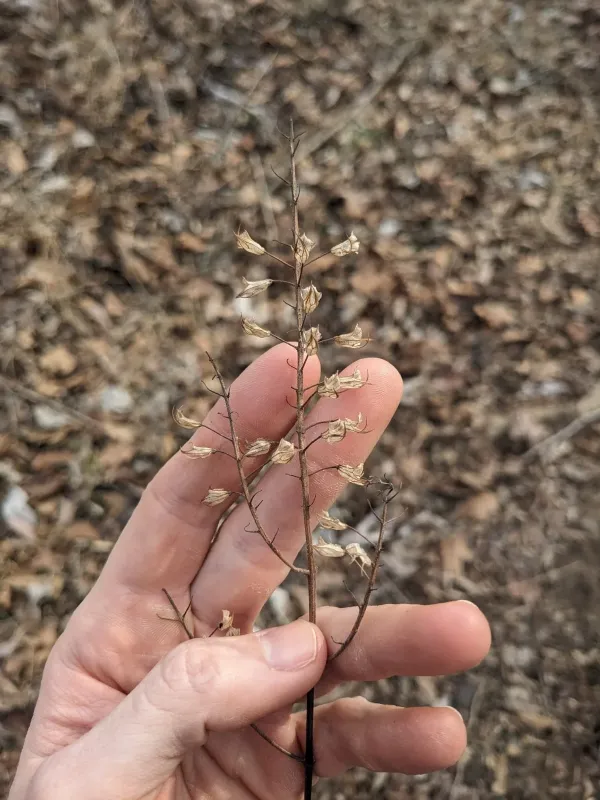
Description
How to tell it apart
Collinsonia canadensis, commonly known as horsebalm or richweed, is a perennial herbaceous plant belonging to the Lamiaceae family. It is characterized by its robust rhizomes and an erect stem that can grow up to 1.5 meters in height.
The leaves are large, petiolate, and arranged oppositely along the stem, featuring an ovate shape with serrated margins. A distinctive characteristic is the strong lemon-like scent emitted when the foliage is crushed.
The plant produces yellow, bell-shaped flowers arranged in terminal panicles at the top of the stem. These flowers are notable for their long, protruding stamens, which extend significantly beyond the petals.
Biologically, it is an aggressive perennial that spreads via a strong, creeping root system. Once established, it tends to form dense colonies that are difficult to manage without targeted intervention.
The plant exhibits rapid early-season growth, allowing it to quickly outcompete surrounding vegetation for sunlight and soil nutrients, establishing dominance in its immediate area.
Where it grows
Native to North America, Collinsonia canadensis naturally inhabits moist woodlands and stream banks. In an agricultural context, it favors damp, nutrient-rich soils often found in low-lying areas or irrigated fields.
It frequently colonizes the edges of fields, riparian buffers, and neglected corners of farms. Due to its preference for moisture, it is particularly persistent in areas where irrigation or high water tables occur.
The weed often invades agricultural land if the soil has been disturbed and not adequately replanted. It also thrives in areas that lack regular mechanical cultivation, which is a limiting factor for its growth.
Though not always a widespread field crop weed, its ability to establish in favorable microclimates makes it a persistent nuisance in orchards, perennial plantings, and specialty crop farms.
Root segments can be dispersed by moving soil or running water, allowing the plant to spread into previously clean sections of a field or agricultural landscape.
Harm it causes
The primary harm caused by this plant is its competitive ability to suppress crop growth. By monopolizing soil moisture and nutrients, it reduces the vitality of desired plant species.
Dense colonies create heavy shade, which inhibits the photosynthetic process of low-growing crops, leading to stunted development and significant yield reductions in affected field areas.
The extensive and thick root system interferes with standard mechanical tillage, making it difficult to prepare seedbeds properly and increasing wear on agricultural machinery.
Contamination of harvested material with foliage or root fragments from the weed necessitates additional post-harvest cleaning, which drives up production costs and lowers the quality grade of the final product.
Furthermore, these dense weed patches can serve as overwintering sites for various agricultural pests and pathogens, which can then migrate to cultivated crops during the growing season.
How to control
Mechanical control includes deep plowing to expose rhizomes to the sun, leading to desiccation. It is essential to remove root fragments from the field to prevent the plant from re-rooting.
Regular mowing or cutting of the foliage prior to flowering helps to deplete the starch reserves stored in the rhizomes. Over time, this consistent stress weakens the plants and reduces their spreading ability.
Chemical control usually involves the application of systemic herbicides like glyphosate. Application is most effective during the active growth stage when the plant is transporting nutrients downward to its roots.
Integrated weed management should be applied in perennial settings to ensure the plant does not re-establish. Combining mechanical clearing with targeted herbicide application often yields the best results.
- Deep tillage and soil turning;
- Regular mowing to deplete energy reserves;
- Systemic herbicide application;
- Maintaining competitive crop cover to suppress growth.
Taxonomy
- Latin name
- Collinsonia canadensis
- Family
- Яснотковые
- EPPO code
- CIZCA