
Bugle
Ajuga
Description
How to tell it apart
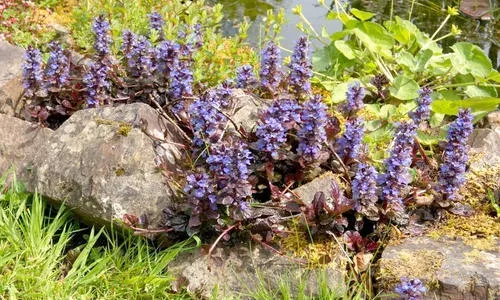
Bugle (genus Ajuga) is a member of the Lamiaceae family. It is a perennial herbaceous plant characterized by its stolons, which allow it to creep along the ground and root at the nodes.
The stems are typically square-shaped, reflecting its mint family lineage. They can be erect or prostrate depending on the environmental conditions and density of the stand.
The leaves are generally arranged in a basal rosette, often having an obovate or elliptical shape. They may be smooth or pubescent, providing a dense ground cover.
The flowers are arranged in terminal spikes, featuring small, distinct blossoms with a prominent lower lip, typical of the Lamiaceae family structure.
Its ability to propagate both by seeds and via vegetative runners makes it a highly invasive species in areas where soil moisture is consistently available.
Where it grows
Bugle thrives in moist, fertile soils and is frequently found in shaded or semi-shaded environments, such as forest edges, meadows, and river banks.
In agricultural settings, it is a significant nuisance in orchards, berry plantations, and on damp arable land that remains undisturbed for long periods.
It often invades perennial pastures, where its aggressive growth habit can displace valuable forage crops, leading to a degradation of the pasture quality.
Abandoned fields and areas with minimal tillage are highly susceptible to infestation, as the plant can rapidly cover large surface areas using its stolons.
The plant demonstrates high ecological plasticity, allowing it to adapt to various moisture levels, although it remains most competitive in humid zones.
Harm it causes
The primary damage caused by bugle is its aggressive competition with crops for soil nutrients and essential moisture, often outcompeting less vigorous seedlings.
The dense vegetative mat formed by the weed prevents proper aeration of the soil and inhibits the development of desirable crop root systems.
Bugle creates a microclimate with high humidity around the base of the crops, significantly increasing the risk of fungal infections and soil-borne diseases.
The presence of this weed complicates mechanical harvesting processes, as the matting growth can clog equipment and interfere with crop cut heights.
As a host for various agricultural pests and pathogens, bugle increases the overall disease pressure on a field, leading to increased costs for pesticide usage.
How to control
Effective control starts with deep plowing, which physically disrupts the stolon system and prevents the weed from spreading further across the field.
Regular cultivation and harrowing are essential to dislodge the shallow root system of the plant, especially during dry weather to ensure the plants desiccate.
Implementing a rigorous crop rotation plan that includes intensive soil cultivation cycles helps to break the life cycle of this persistent perennial.
Chemical control requires the application of selective systemic herbicides, chosen based on the sensitivity of the crops currently being grown in the field.
- Deep soil plowing.
- Frequent mechanical cultivation.
- Systemic herbicide application.
Taxonomy
- Latin name
- Ajuga
- Family
- Яснотка пурпурная
- EPPO code
- AIUSS