
Najas graminea
Najas graminea
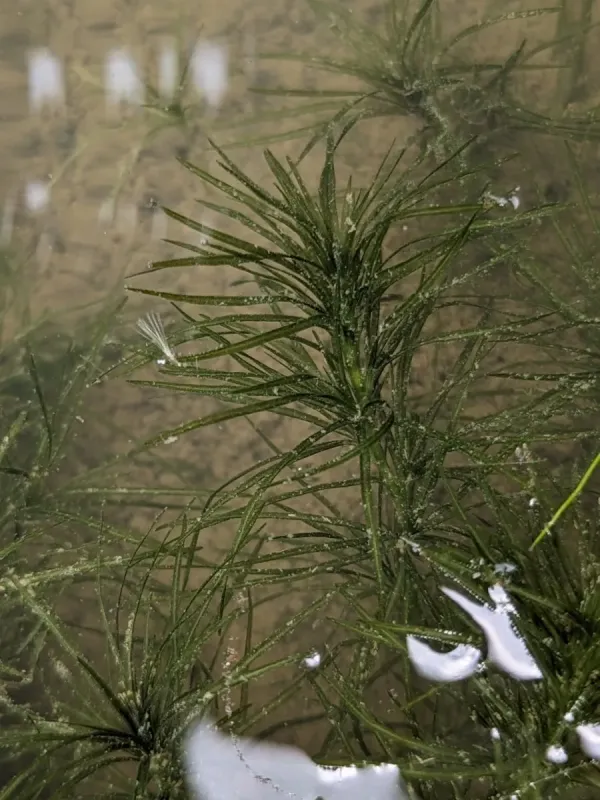
Description
How to tell it apart
Najas graminea (commonly known as grass-leaf naiad) is an annual submerged aquatic plant belonging to the Hydrocharitaceae family. It is recognized for its slender, grass-like leaves.
The plant features highly branched, brittle stems that can grow up to 60 cm in length. The leaves are narrow, linear, and arranged in opposite or whorled patterns, possessing microscopic teeth along the margins.
Root systems are relatively rudimentary, consisting of fine, thread-like structures that anchor the plant weakly in the silt or sandy bottom of aquatic environments.
It reproduces primarily through seeds, which remain viable in the soil for extended periods, and through vegetative propagation, where fragmented stems easily re-root in waterlogged soil.
Flowering occurs underwater and is quite inconspicuous, making early detection difficult before the plant forms dense, mat-like colonies that fill the water column.
Where it grows
Najas graminea typically thrives in freshwater environments, such as stagnant or slow-moving lakes, irrigation ditches, ponds, and especially artificial wetlands like paddy fields.
It prefers nutrient-rich muddy or sandy substrates, which provide the essential minerals and stable conditions required for rapid biomass accumulation during the growing season.
In agricultural settings, the plant is considered a serious weed due to its aggressive colonization of flooded rice fields, where it quickly outcompetes young rice seedlings.
Warm water temperatures during the summer months are optimal for its development, allowing the plant to rapidly reach its full growth potential within a few weeks of flooding.
Dispersal is frequently facilitated by water movement through irrigation infrastructure, which carries both seeds and broken vegetative parts to new, previously uninfested fields.
Harm it causes
The primary economic harm caused by Najas graminea is the clogging of irrigation systems and canals, which restricts water flow and disrupts the timely irrigation of crops.
In rice paddies, the dense underwater mats impede light penetration and nutrient uptake for rice plants, which can significantly reduce final crop yields and quality.
The massive biomass of this weed, upon decay, contributes to water quality degradation and creates an environment prone to anaerobic decomposition and pathogens.
Mechanical operations in rice fields, such as fertilization or pesticide application, become much more complex and less efficient due to the presence of dense Najas mats covering the field bottom.
Infestation also necessitates increased labor and financial costs for mechanical cleaning and dredging of channels to ensure the proper functioning of the entire irrigation network.
How to control
Effective management begins with strict field hygiene, including the clearing of irrigation channels and the use of weed-free rice seeds to prevent initial introduction.
Draining the fields during the off-season or at specific critical intervals is a highly effective control measure, as the plant is highly sensitive to desiccation and soil drying.
Chemical control involves the use of specialized aquatic herbicides approved for use in rice cultivation, which are designed to target submerged weeds without affecting the crop.
Water level management is a key cultural practice; maintaining appropriate depths that allow the rice to thrive while limiting the light reaching the bottom can inhibit Najas growth.
Integrated weed management, combining preventative cultural practices, targeted herbicide applications, and consistent channel maintenance, is essential for long-term control of this invasive species.
Taxonomy
- Latin name
- Najas graminea
- Family
- Водокрасовые
- EPPO code
- NAIGR