
Lagarosiphon muscoides
Lagarosiphon muscoides
Description
How to tell it apart
Lagarosiphon muscoides belongs to the Hydrocharitaceae family. It is a perennial submerged freshwater plant often confused with Elodea due to its physical appearance.
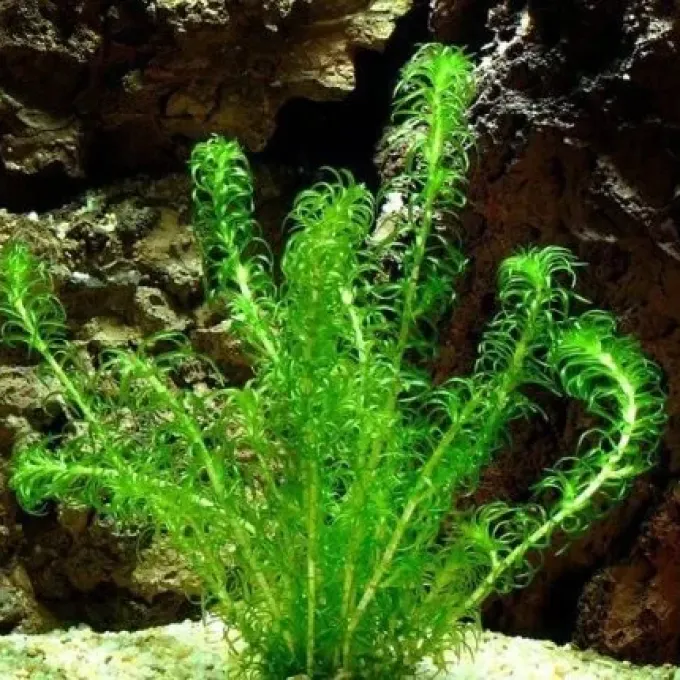
The plant has elongated stems that can reach several meters in length. These stems are densely covered with small, narrow, dark green leaves arranged in a spiral or opposite pattern.
A key morphological feature is that the leaves have a characteristic downward curve, giving the plant a curled appearance. It is capable of forming dense underwater mats.
The root system is weakly developed, and the plant often leads a free-floating or loosely attached lifestyle. Reproduction is primarily vegetative, through the fragmentation of stems.
The flowers are small, solitary, and develop on long stalks that reach the water's surface, facilitating cross-pollination within the aquatic environment.
Where it grows
The plant is native to tropical and subtropical regions of Africa. In its natural environment, it prefers freshwater lakes, ponds, and slow-moving rivers.
Over recent decades, the species has become invasive in many countries, including parts of Europe and New Zealand. It has successfully adapted to various temperature regimes.
Lagarosiphon prefers standing or slow-flowing water with soft or silty bottoms. The plant can survive at considerable depths provided there is sufficient light.
Its rapid spread in irrigation canals and reservoirs poses a specific danger. The ability to survive in low-temperature conditions has expanded its range of expansion.
Human activities contribute to the spread of this weed through the transport of plant fragments on fishing gear, boats, and aquarium equipment.
Harm it causes
The main harm lies in the ability of Lagarosiphon to create ultra-dense mats that completely displace local aquatic vegetation, thereby reducing biodiversity.
Dense accumulations of biomass physically obstruct the navigation of vessels and interfere with commercial fishing activities, leading to significant economic losses.
The weed mats negatively affect water quality by altering dissolved oxygen levels, which often causes the death of local fish species and shifts in pH balance.
In the agricultural sector, the plant clogs pumping stations, irrigation channels, and drainage systems, disrupting water supply to crops and threatening flooding.
The mass die-off of biomass in autumn triggers decay processes that release toxic substances and increase the eutrophication of water bodies, degrading the environment.
How to control
Mechanical control includes regular mowing or harvesting of biomass using specialized weed-cutting boats to clear riverbeds and irrigation channels.
A crucial preventative measure is the thorough cleaning of fishing gear and boats before moving between different water bodies to prevent the transport of vegetative parts.
Biological control methods are currently under study, although the use of specific pathogens or herbivores has not yet shown high efficacy in field conditions.
Chemical control is carried out using broad-spectrum aquatic-approved herbicides, though this requires strict adherence to environmental regulations and guidelines.
Agrotechnical control in irrigation systems involves the temporary drainage of channels, which causes the plant to dry out and die, as it is highly sensitive to desiccation.
Taxonomy
- Latin name
- Lagarosiphon muscoides
- Family
- Водокрасовые
- EPPO code
- LGAMU