
Curly waterweed
Lagarosiphon major
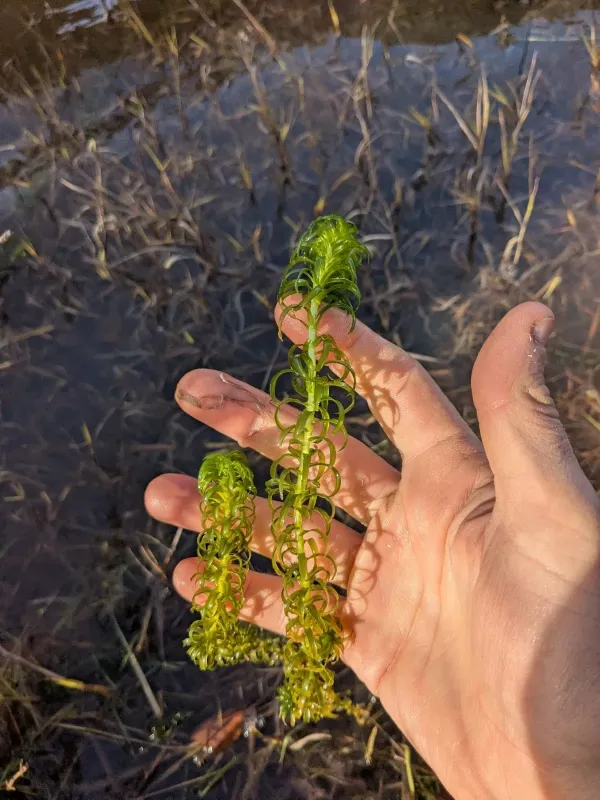
Description
How to tell it apart
Lagarosiphon major, commonly known as Curly waterweed, is a submerged perennial aquatic plant belonging to the Hydrocharitaceae family.
It is distinguished by its stems, which can grow up to 3 meters in length, and its distinctively curled, dark green leaves arranged in a spiral pattern around the stem.
The plant forms dense, tangled mats that fill the water column, effectively excluding almost all other forms of aquatic vegetation.
It propagates almost exclusively by vegetative fragmentation, where even tiny pieces of the stem can break off and establish new colonies elsewhere.
Unlike many other plants, it lacks significant dormancy periods, allowing it to continue growing even in cooler water temperatures compared to native species.
Where it grows
Native to Southern Africa, this species has become a highly successful invader in New Zealand, Europe, and parts of the United States.
It thrives in freshwater environments, including lakes, ponds, reservoirs, and drainage canals where water movement is minimal or slow.
The plant is particularly problematic in agricultural irrigation channels, where it disrupts water flow and maintenance of hydro-technical infrastructure.
It can inhabit depths from shallow margins down to approximately 6 meters, depending on water clarity and the availability of light.
Human activity is the primary vector for its dispersal, facilitated by recreational boating, fishing equipment, and the aquarium trade.
Harm it causes
The dense biomass produced by Curly waterweed severely impacts aquatic ecosystems by significantly reducing oxygen levels during the night.
It creates monospecific stands that displace native plant species, leading to a profound loss of biodiversity in infested freshwater bodies.
For agriculture, the plant is a major nuisance as it clogs water intake screens, drainage pumps, and increases sedimentation within irrigation networks.
Recreational activities such as swimming, rowing, and fishing become hazardous or impossible due to the thick, rope-like stems that can entangle users.
The accumulation of decaying plant matter alters the chemical composition of the water, promoting further degradation and eutrophication processes.
How to control
Mechanical harvesting is a common approach, involving specialized machines or manual removal, though it must be carefully done to avoid spreading fragments.
Benthic barriers, made of dark fabrics, are placed on the bottom to prevent sunlight from reaching the plants, effectively starving them of energy.
Water level drawdowns in reservoirs or canals are a highly effective agrotechnical method to desiccate or freeze the plant biomass during off-seasons.
Chemical control using aquatic-approved herbicides is possible but strictly regulated due to potential risks to non-target aquatic organisms.
- Regular inspection of water bodies for early signs of infestation.
- Strict hygiene protocols for cleaning boats and fishing gear.
- Public education programs to prevent release from home aquariums.
- Implementation of quarantine zones for heavily infested areas.
Taxonomy
- Latin name
- Lagarosiphon major
- Family
- Водокрасовые
- EPPO code
- LGAMA