
Hydrilla
Hydrilla verticillata
Description
How to tell it apart
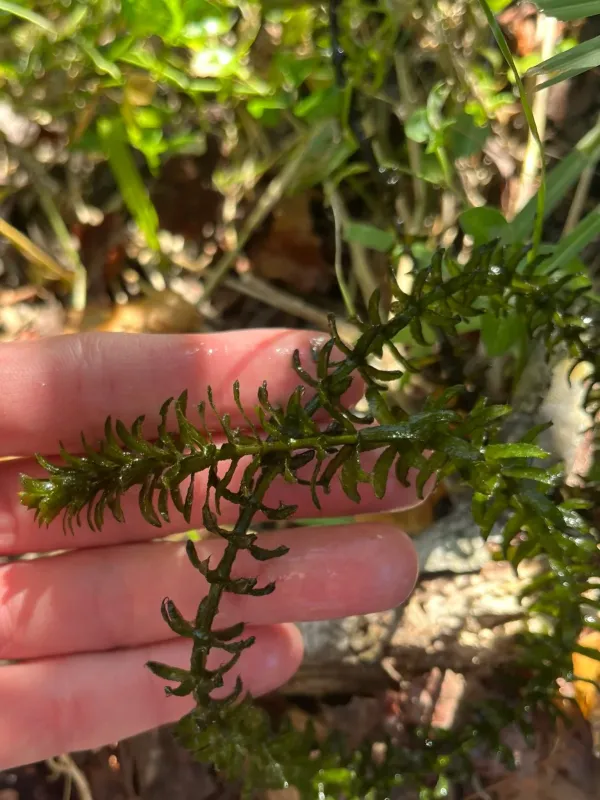
Hydrilla verticillata belongs to the Hydrocharitaceae family. It is a perennial submerged aquatic plant that resembles Elodea but features more prominent whorled leaf structures.
The stems can grow several meters long and are highly branched. Leaves are arranged in whorls of 3 to 8, with serrated margins that make them feel rough to the touch.
A critical identification feature is the presence of small underground tubers, which allow the plant to survive harsh conditions and overwinter in bottom sediments.
The flowers of Hydrilla are tiny, whitish or slightly reddish, and are borne on long stalks that reach or extend above the water surface.
The root system is weakly developed, so the plant often anchors using rhizoids, easily detaching and spreading via stem fragments along water currents.
Where it grows
The plant prefers still or slow-moving water bodies such as lakes, ponds, canals, and irrigation systems. It adapts to a wide range of light and temperature levels.
Hydrilla aggressively colonizes shallow areas, forming dense mats from the bottom to the water surface, which drastically alters the local aquatic ecosystem.
In agricultural regions, Hydrilla is a significant nuisance in irrigation canals, blocking water intakes, pumping stations, and distribution channels, severely reducing efficiency.
The plant possesses high physiological plasticity, allowing it to withstand significant water level fluctuations and varying salinity, making it a highly dangerous invasive species.
Dispersal occurs primarily vegetatively: stem fragments, turions, and tubers are transported by water currents, recreational equipment, and waterfowl.
Harm it causes
The primary damage caused by Hydrilla is the displacement of native flora and fauna. Dense mats block sunlight from reaching other submerged plants, leading to their decline.
In irrigation farming, Hydrilla acts as a major obstruction, clogging essential infrastructure and reducing water flow, which can lead to crop failures during dry periods.
The decay of massive biomass at the end of the growing season causes oxygen depletion (hypoxia), which often results in mass fish kills in affected water bodies.
Dense infestations create perfect breeding grounds for mosquitoes and other disease vectors, while also interfering with fishing, boating, and swimming activities.
Hydrilla accelerates sediment accumulation, speeding up the process of eutrophication and the shallowing of both artificial and natural ponds.
How to control
Mechanical control involves the use of specialized harvesting machines to remove biomass from the water, although this approach requires frequent repetition for effectiveness.
Biological control methods often involve the introduction of herbivorous fish, such as grass carp, which are capable of significantly reducing Hydrilla populations.
Chemical control utilizes aquatic-labeled systemic herbicides, which must be applied according to strict environmental regulations to minimize ecological impact.
Preventive measures include strict boat cleaning protocols and monitoring of recreational gear to prevent the accidental introduction of plant fragments into uninfested areas.
- Dredging and removal of tubers during the off-season.
- Use of benthic barriers to prevent light penetration.
- Early detection and rapid response to small infestations.
Taxonomy
- Latin name
- Hydrilla verticillata
- Family
- Водокрасовые
- EPPO code
- HYLLI