
Elodea callitrichoides
Elodea callitrichoides
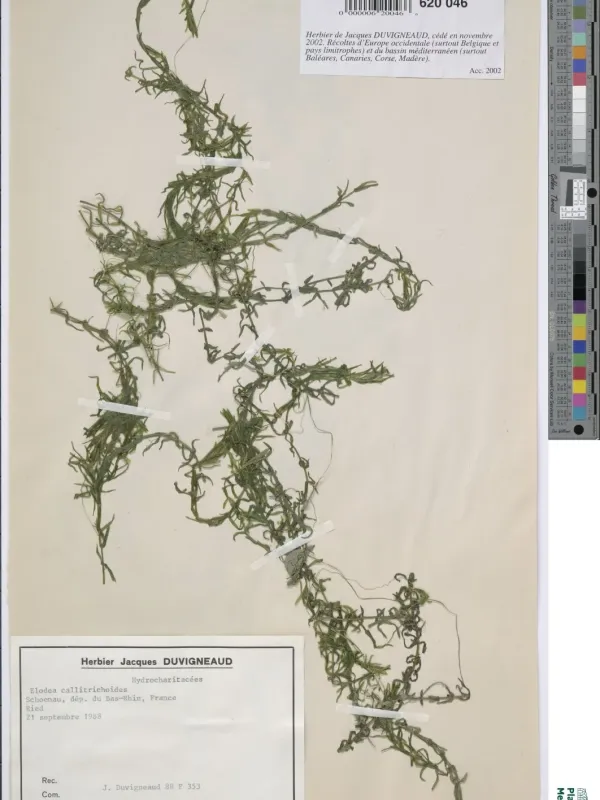
Description
How to tell it apart
Elodea callitrichoides is a perennial submerged aquatic plant belonging to the Hydrocharitaceae family. It is characterized by slender, brittle, and highly branched stems that can grow to several meters in length.
The leaves are arranged in whorls, typically three per node. They are linear-lanceolate, quite thin, and bright green, which allows the plant to efficiently utilize sunlight even in deeper or turbid water columns.
The plant lacks true roots for nutrient absorption, relying instead on its submerged foliage to extract minerals directly from the water. Rhizoids are used solely for anchoring the plant into the substrate.
Reproduction is almost entirely vegetative. Small fragments of the stem, each possessing a node, are capable of developing into independent, fully functional plants, which facilitates rapid colonization.
It can be distinguished from other Elodea species by its delicate morphology and its tendency to form exceptionally dense, tangled mats that are difficult to penetrate.
Where it grows
This species thrives in slow-moving or stagnant freshwater habitats, including ponds, irrigation ditches, and slow canals. It requires calm water to establish its extensive root-like structures.
The plant is highly responsive to nutrient enrichment. Eutrophic waters, rich in nitrogen and phosphorus runoff from agricultural fields, provide the ideal conditions for its explosive growth.
It is commonly found in human-made drainage systems where the water flow is restricted, allowing the plant to carpet the entire bottom and obstruct the channel profile.
While tolerant of various temperatures, it prefers temperate and warm climates where the growth season is long, and the water body does not freeze to the bottom, which would kill the vegetative tissues.
The ability to adapt to different light conditions makes it a versatile invader in various aquatic environments, from shallow ponds to deeper reservoirs.
Harm it causes
Elodea callitrichoides is a major nuisance in water management. Its dense mats drastically reduce water flow, leading to sedimentation, increased flood risks, and failure of irrigation infrastructure.
The plant poses a significant threat to aquatic biodiversity by shading out native plant species and destroying the natural habitat of benthic organisms through the formation of monocultures.
It negatively impacts water quality due to high nocturnal oxygen consumption. This causes dissolved oxygen levels to drop significantly, creating hypoxic conditions that can be fatal to fish and invertebrates.
For commercial aquaculture and recreation, the weed makes water bodies unusable. It fouls fishing gear, clogs boat propellers, and accumulates decaying organic matter that produces foul odors.
The massive biomass of decaying plant material can lead to increased nutrient cycling within the water column, further fueling the growth of algae and exacerbating the eutrophication process.
How to control
Mechanical management involves the use of specialized aquatic harvesters. It is critical that all cut vegetation is removed from the water, as any leftover fragments can quickly establish new populations.
Draining the water body (drawdown) is a highly effective control method. Exposing the plant to dry conditions and frost is the most reliable way to kill the vegetative mass in irrigation canals.
Chemical control must be performed using herbicides specifically approved for aquatic use, such as diquat or fluridone, ensuring that water safety standards for irrigation and livestock are maintained.
Biological control can be implemented by introducing herbivorous fish, primarily the grass carp (Ctenopharyngodon idella), which can significantly reduce the biomass of Elodea in managed ponds.
Long-term control focuses on nutrient management. By reducing fertilizer runoff and industrial discharges into the waterway, the excessive growth of this invasive plant can be effectively curtailed.
Taxonomy
- Latin name
- Elodea callitrichoides
- Family
- Водокрасовые
- EPPO code
- ELDER