
Elodea bifoliata
Elodea bifoliata
Description
How to tell it apart
Elodea bifoliata is an aquatic plant species belonging to the Hydrocharitaceae family. It is a submerged perennial that thrives in freshwater environments, often forming dense underwater carpets.
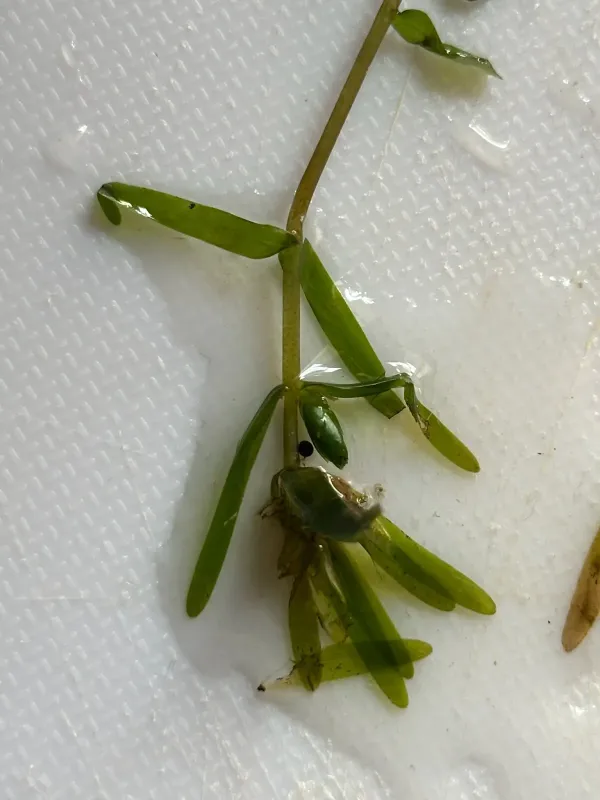
The plant is characterized by brittle stems that easily fragment. Its leaves are arranged in whorls, typically consisting of two or three leaves, which have a distinctive linear-lanceolate shape.
The species is highly adapted to vegetative propagation. Each individual node or fragment can develop into a complete new plant, allowing for rapid colonization of new water bodies.
It lacks deep rooting, relying on adventitious roots or simple anchoring to the substrate, while primarily extracting minerals from the water column through its foliage.
Under favorable environmental conditions, the plant exhibits rapid vertical growth, often reaching the water surface, which is a key identifying feature when surveying infested canals or ponds.
Where it grows
Elodea bifoliata is primarily found in stagnant or slow-moving water bodies, including irrigation canals, drainage ditches, ponds, and shallow lake margins.
In agricultural settings, this weed is a major concern for irrigation infrastructure. It creates significant blockages in water conveyance systems that are vital for crop production.
The plant favors nutrient-rich water, which is common in agricultural areas where nitrogen and phosphorus runoff from fields enters the drainage network.
It displays high tolerance to varying light conditions, allowing it to occupy diverse niches within a water body, from deep murky waters to bright sunlit shallows.
Dispersal is primarily driven by water movement, where stem fragments are transported downstream, eventually settling and establishing new, dense weed beds.
Harm it causes
The primary harm caused by Elodea bifoliata is the clogging of irrigation and drainage canals. These dense masses restrict water flow, causing significant delays or shortages in water supply to cultivated fields.
The accumulation of plant matter increases maintenance costs, as agricultural enterprises must invest in frequent mechanical cleaning of canals to ensure water delivery.
Invasive colonies significantly degrade water quality by reducing dissolved oxygen levels as the biomass decomposes, which can lead to negative impacts on aquatic fauna.
Operational damage is a frequent issue, as plant fragments are drawn into water intake systems, damaging pumps, clogging irrigation nozzles, and forcing costly equipment downtime.
Furthermore, the species crowds out native aquatic flora, leading to a loss of biodiversity and altering the ecological health of the water management network.
How to control
Mechanical harvesting is the most common and effective method of control. Specialized machinery, such as aquatic weed cutters and rakes, is used to remove large quantities of biomass from canals.
Preventative strategies include managing nutrient runoff from agricultural fields to reduce the availability of fertilizers in the water, which limits the weed's explosive growth potential.
Chemical control involving aquatic-approved herbicides can be used, but this method is subject to strict environmental regulations to prevent downstream contamination and harm to aquatic life.
- Mechanical harvesting and dredging.
- Water level management (drawdowns).
- Nutrient runoff reduction.
- Biological control using herbivorous fish.
Winter drainage or complete desiccation of canals is a highly effective cultural control method, as it exposes the weed fragments to freezing or drying conditions, effectively killing the population.
Taxonomy
- Latin name
- Elodea bifoliata
- Family
- Водокрасовые
- EPPO code
- ELDLO