
Sphaerophysa salsula
Sphaerophysa salsula
Description
How to tell it apart
Sphaerophysa salsula, known as alkali swainsonpea, belongs to the Fabaceae family. It is a perennial herbaceous plant with an extensive and deep-reaching root system, capable of regenerating from root fragments.
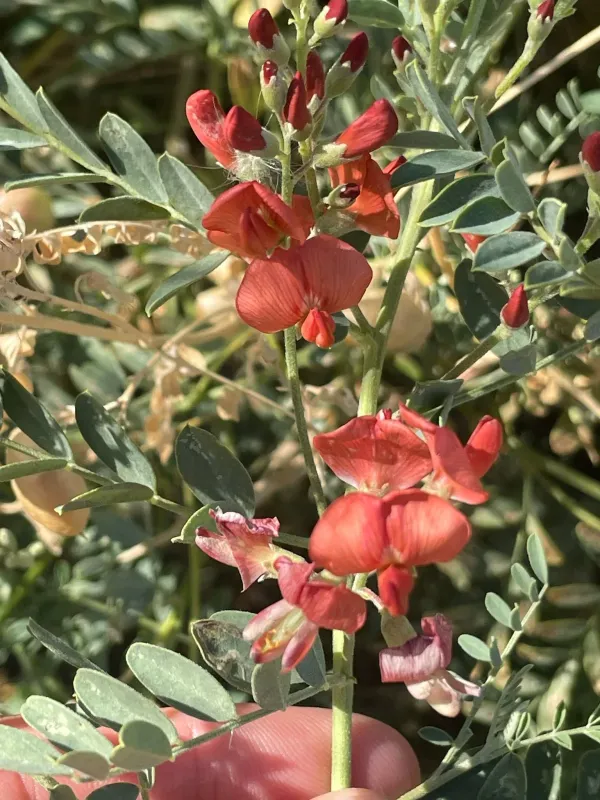
The stems are erect and branched, growing between 30 and 80 cm tall. The leaves are imparipinnate, featuring numerous small leaflets covered with fine hairs, which gives the foliage a grayish-green appearance.
The flowers are typically pea-like, exhibiting a distinct reddish-orange or brick color. They are arranged in loose racemes arising from the leaf axils.
The fruit is a characteristic inflated, membranous pod that is egg-shaped or spherical. These pods contain numerous kidney-shaped seeds that are easily dispersed by wind and water.
This weed is highly resilient due to its clonal growth habit. The plant spreads primarily through vegetative propagation via horizontal roots, making it extremely difficult to eradicate once established.
Where it grows
As the scientific name suggests, this plant is adapted to saline environments. It is commonly found on alkaline soils, salt flats, and along water bodies in arid and semi-arid regions.
In agricultural settings, it is a persistent weed in various field crops, including cereals, row crops, and vegetable farms, particularly where irrigation is practiced.
The weed often colonizes non-cropped areas such as ditch banks, road verges, and waste lands, which act as reservoirs for further infestation of productive farmland.
It exhibits high ecological plasticity, allowing it to survive under extreme temperature fluctuations and varying soil moisture conditions, from waterlogged to quite dry.
Once established in a field, the plant can form dense, monospecific stands that crowd out desired vegetation and disrupt the growth of nearby crop plants.
Harm it causes
Sphaerophysa salsula is a severe competitor for nutrients and water. Its deep roots allow it to extract moisture from deep soil profiles, depriving the crop of essential resources.
The weed significantly reduces agricultural yields through competition for light and space. In cases of heavy infestation, farmers can face crop yield losses of up to 50 percent.
It can serve as an alternative host for various crop pathogens and insects, complicating pest management programs and increasing the need for chemical applications.
The presence of this weed creates logistical issues during harvest. Dense patches of the plant can clog combines and other machinery, significantly reducing operational efficiency.
Seed contamination is another major concern. The small seeds of Sphaerophysa salsula are difficult to separate from many grain and forage seed crops, leading to lower-quality produce.
How to control
Controlling this weed requires a long-term strategy, as simple mechanical removal often triggers further growth from the extensive root system.
Cultural control methods include deep plowing and clean fallowing, which help to exhaust the carbohydrate reserves stored in the plant's roots over several seasons.
Chemical control involves the use of systemic herbicides, such as those containing 2,4-D or dicamba, applied during the active growth phase, preferably before the onset of flowering.
Integrated weed management, combining tillage practices with herbicide applications, is essential for reducing population density and preventing further spreading.
Crop rotation with competitive, fast-growing cover crops can help shade out Sphaerophysa salsula, suppressing its development and making chemical control more effective.
Taxonomy
- Latin name
- Sphaerophysa salsula
- Family
- Бобовые
- EPPO code
- SWASA