
Red sesbania
Sesbania punicea
Description
How to tell it apart
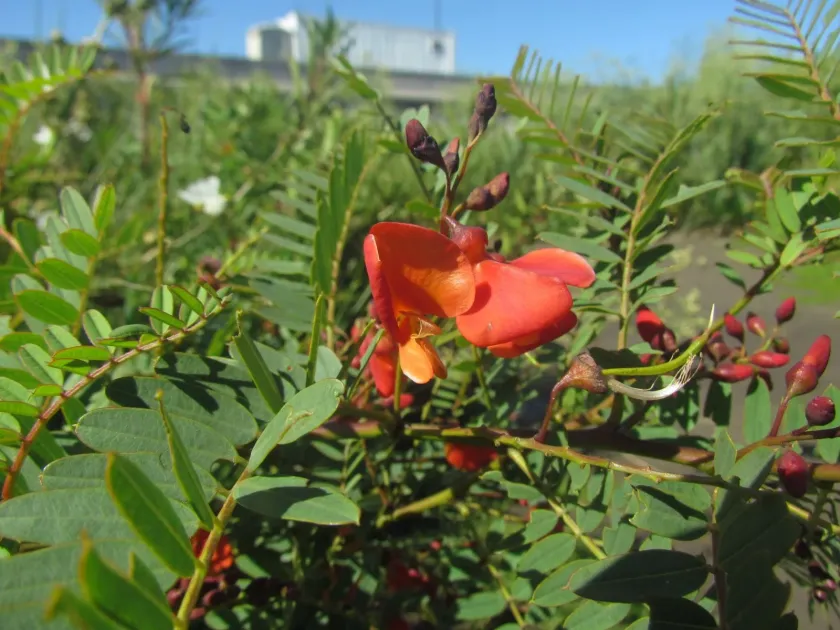
Red sesbania (Sesbania punicea) is a perennial shrub or small tree belonging to the Fabaceae family. It can reach heights of up to 4 meters under favorable conditions.
The leaves are compound, alternate, and pinnate, consisting of numerous small leaflets. This structure provides a lush appearance during the vegetative phase.
The plant is best identified by its vibrant, pea-shaped reddish-orange to purple flowers, which appear in dense, drooping racemes during the spring and summer.
The pods are distinctively four-winged, light brown when mature, and remain attached to the plant for extended periods, facilitating seed dispersal.
The root system is robust and capable of nitrogen fixation, which allows the plant to thrive even in nutrient-poor soils.
Where it grows
Native to South America, Red sesbania has become a problematic invasive species in various parts of the world, including the United States, South Africa, and Australia.
It prefers high-moisture environments. You will typically find it thriving along riverbanks, lake edges, wetlands, and other riparian zones.
In agricultural settings, it frequently colonizes irrigation ditches and flood-prone fields, where it can quickly establish dense, impenetrable thickets.
The plant often spreads into disturbed areas like roadsides, construction sites, and waste lands, from where it invades adjacent agricultural land.
Its ability to tolerate periodic flooding and varying soil conditions makes it a highly successful colonizer in diverse landscapes.
Harm it causes
The primary concern with Red sesbania is its toxicity. All parts of the plant, especially the seeds, contain toxic saponins that are dangerous to livestock.
As an invasive species, it forms dense monocultures that outcompete native plants and agricultural crops for water, light, and soil nutrients.
It obstructs waterways and irrigation systems, reducing the efficiency of water management and potentially leading to localized flooding.
The plant's rapid growth cycle means it can quickly overwhelm young crops, leading to significant yield losses in infested farming operations.
Its aggressive nature disrupts local biodiversity and increases management costs for landowners who must deal with its persistent spread.
How to control
Manual control involves pulling out young plants, ensuring that the entire root system is removed, as any remaining fragments can potentially resprout.
Cultural methods include regular cultivation and deep plowing of infested areas to suppress seed germination and destroy seedling stands.
Chemical control is effective using systemic herbicides, which should be applied to foliage during the active growth period to ensure translocation.
Biocontrol agents have been investigated and utilized in some regions, specifically seed-feeding weevils, to limit the plant's reproductive success.
- Monitor and treat riparian zones early.
- Apply systemic herbicides to mature stands.
- Prevent seed formation to limit long-term spread.
Taxonomy
- Latin name
- Sesbania punicea
- Family
- Бобовые
- EPPO code
- SEBPU